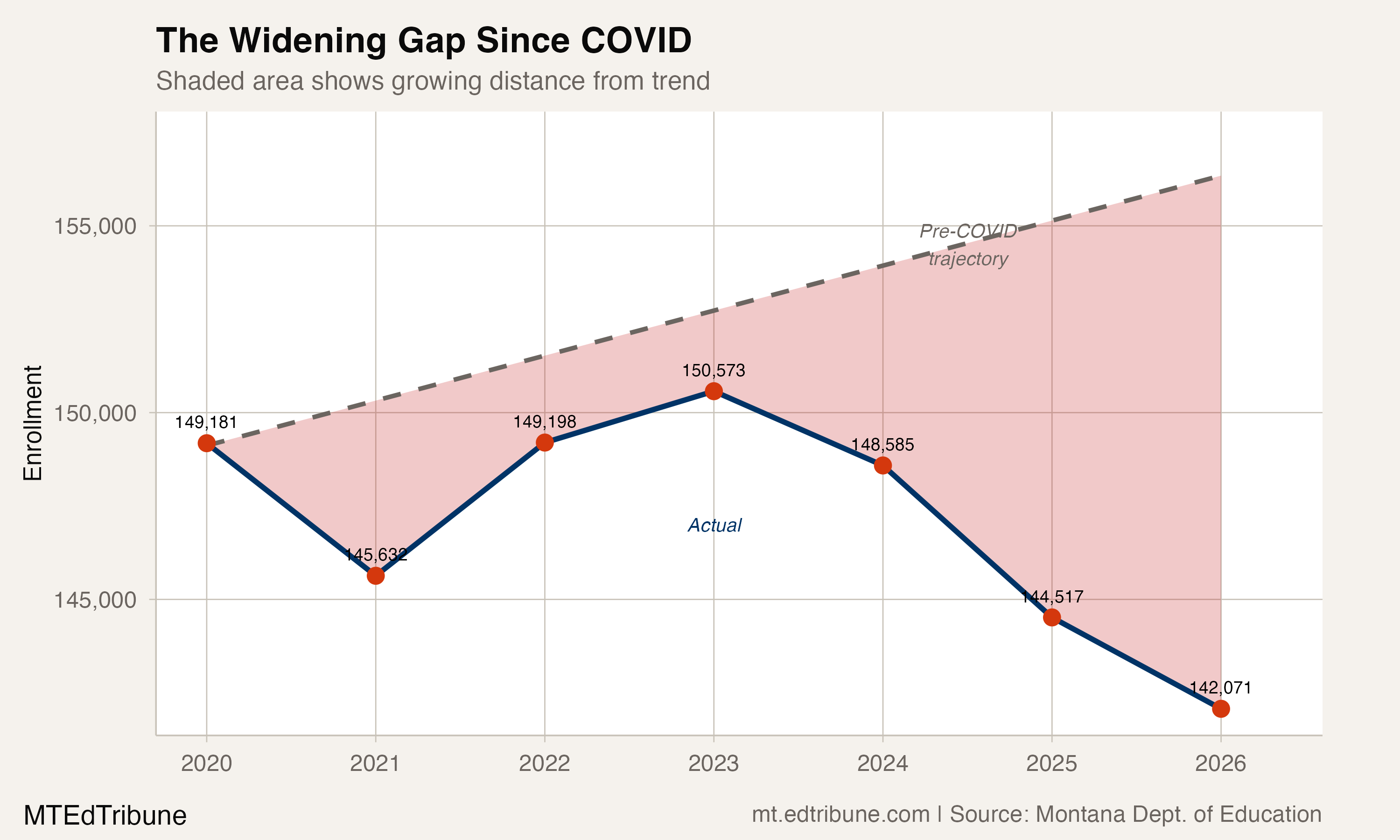
In 2023, Montana's schools looked like they had dodged the worst of it. Enrollment hit 150,573 that year, a record in the nine-year dataset, driven by a post-pandemic bounce of 3,566 students in a single year. The growth trajectory from 2018 through 2020, roughly 1,200 students per year, seemed intact. The COVID dip of 2021 looked like a one-year stumble.
Three years later, Montana has 142,071 students. Had the pre-pandemic growth trend continued, it would have 156,408. The distance between those two numbers, 14,337 students, represents a 9.1% shortfall against the trajectory the state was on before everything changed.
A gap that accelerated
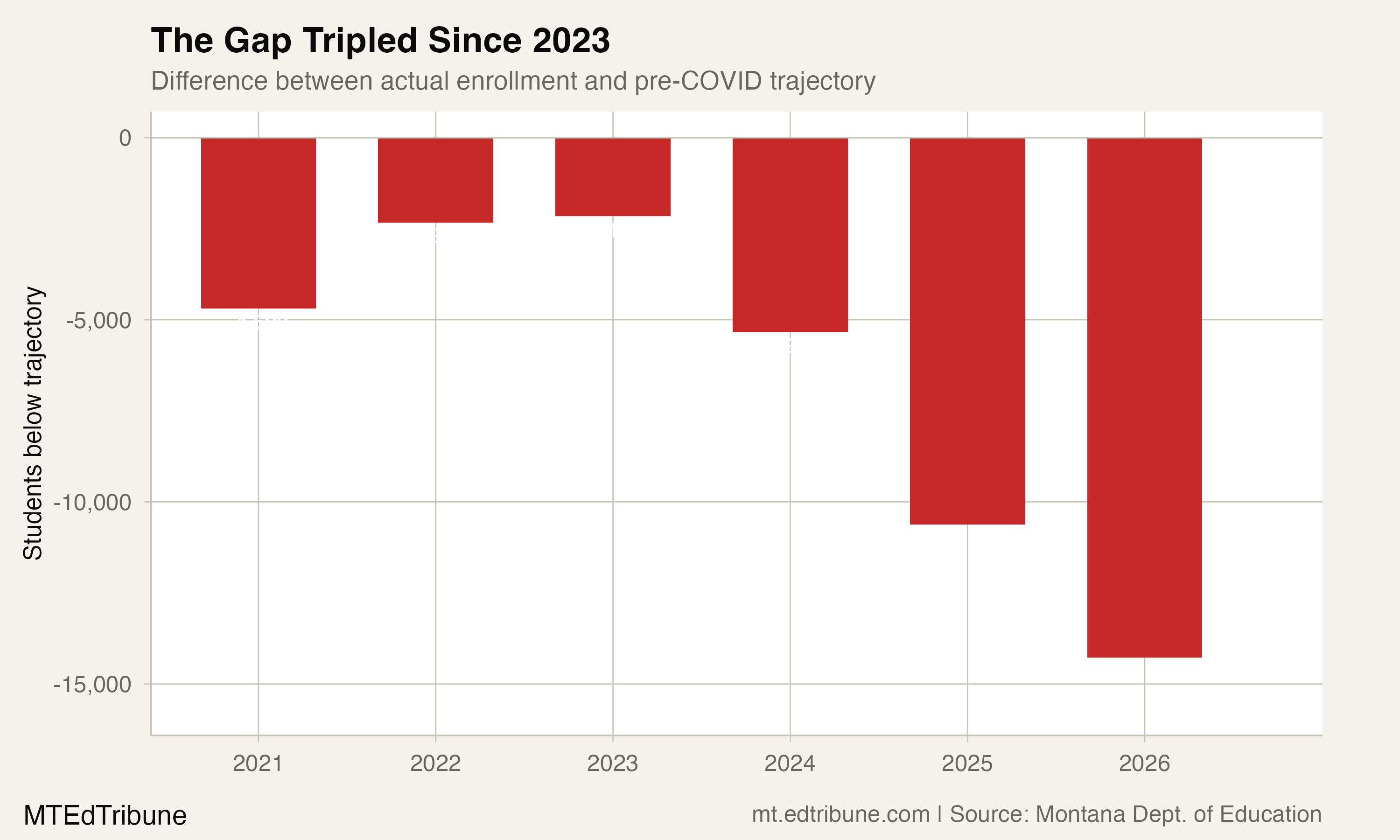
The trajectory model is simple: a linear projection of the 2018-2020 growth rate, which averaged 1,205 students per year. In 2023, when enrollment was near its peak, the gap between actual and projected was modest: 2,158 students, or 1.4%. The trendline and reality were close enough to touch.
Then they separated. In 2024, the gap tripled to 5,350 as enrollment dropped by 1,988 students while the projected line kept climbing. In 2025, it doubled again to 10,623. By 2026, it reached 14,337, a distance that has grown sixfold in three years.
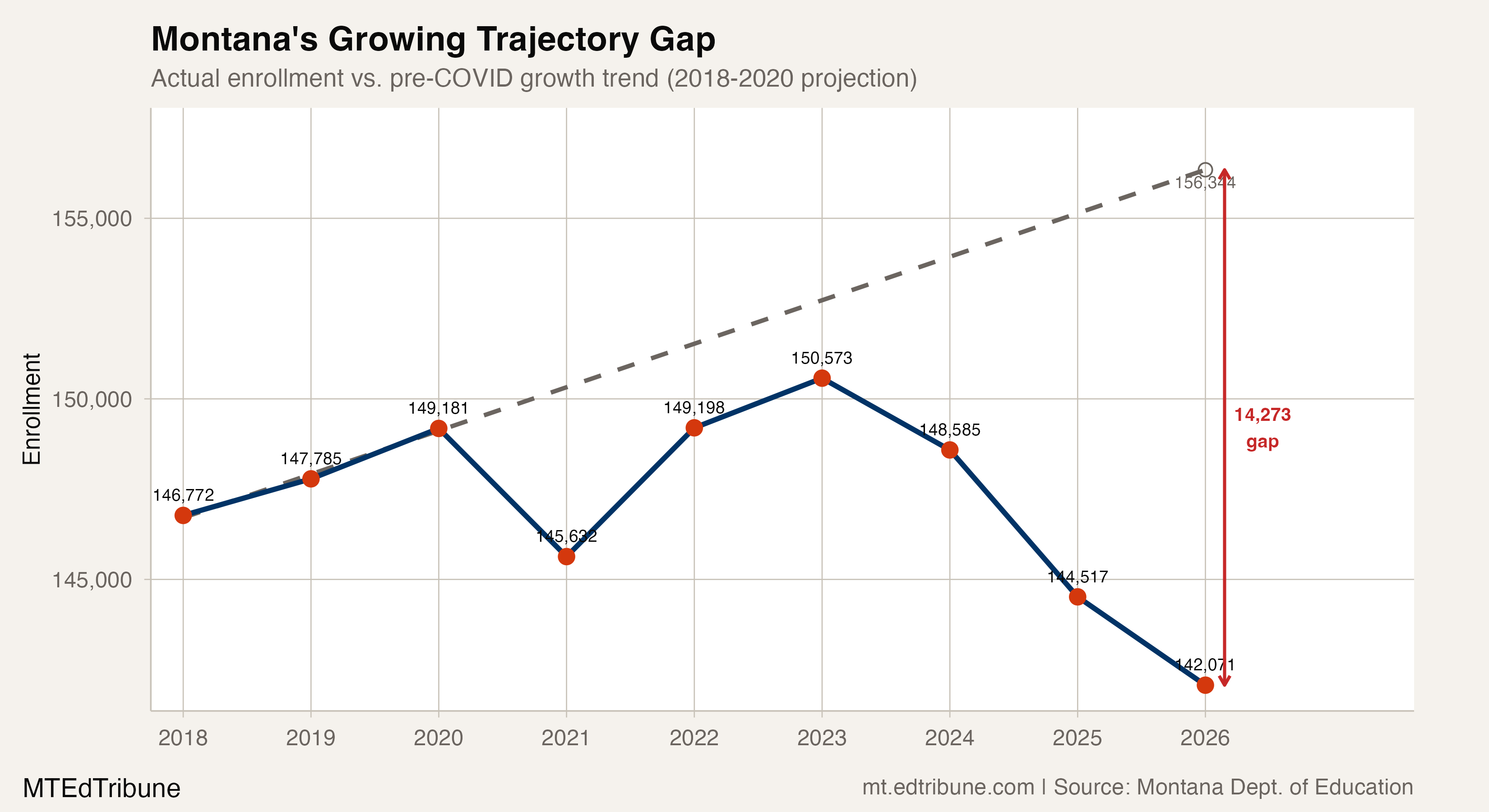
The mechanics are straightforward: the gap grows from both directions. Actual enrollment is falling (down 8,502 since 2023) while the projected line keeps adding 1,205 students per year. Each year of decline digs the hole deeper and moves the target further away.
The budget math
Montana funds schools through Average Number Belonging, a per-student formula that determines both state aid and maximum general fund budgets. Fewer students means fewer dollars. A gap of 14,337 students translates to roughly $97 million in state funding that would have flowed to districts had the growth trajectory held.
That is theoretical money, the difference between what was expected and what arrived. The actual budget pain is more tangible. Billings Elem↗ET, the state's largest district, is 1,000 students below its 2020 enrollment and has cut its elementary budget by $4 million. Missoula Elem↗ET, down 757 from 2020, faced an $8 million shortfall and planned staff reductions. Helena's superintendent Rex Weltz, confronting a plan to cut nearly 100 positions, described the end of pandemic relief funding this way: "We got a glimpse of what it could be with that funding. It's like, this is what education should be."
The state's funding formula includes a three-year ANB average that softens the blow for declining districts. Instead of an immediate drop to their current headcount, districts use the higher of their current enrollment or their three-year average. For 2026, the statewide three-year average is 145,058 compared to the actual 142,071, buying districts a buffer of roughly 3,000 students. But the buffer only delays the reckoning. It cannot reverse it.
Who recovered, who didn't
Of 390 Montana districts that appear in both 2020 and 2026 data, 160 (41.0%) have recovered to or exceeded their pre-COVID enrollment. That leaves 230 districts, a clear majority, still below where they stood six years ago.
The recovery rate follows a clear gradient: the smaller the district, the better the odds.
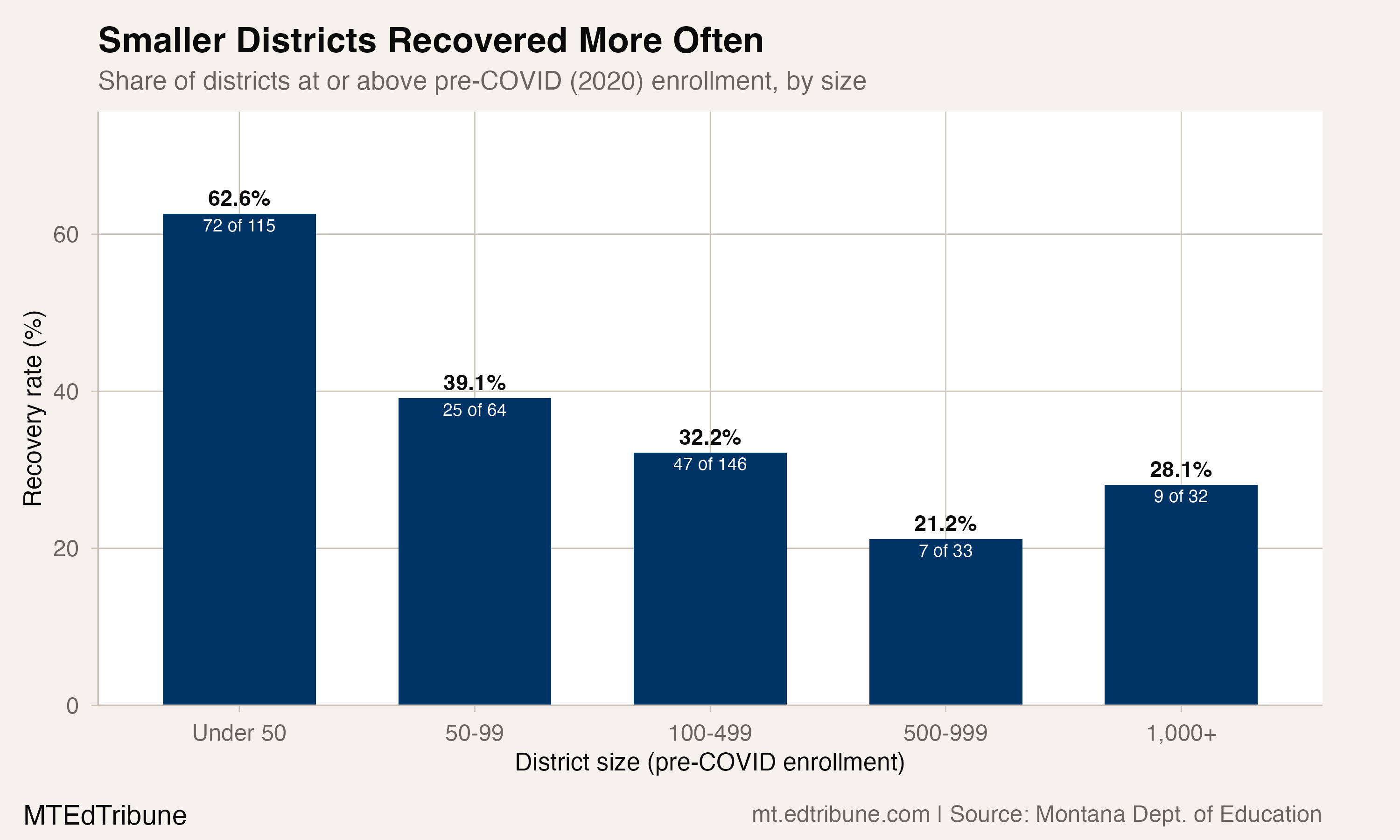
Among the 115 districts with fewer than 50 students, 62.6% have recovered. At the other end, only 7 of 33 mid-size districts (500-999 students, 21.2%) and 9 of 32 large districts (1,000+, 28.1%) have returned to 2020 levels. This is partly arithmetic: a district of 12 students needs to gain one child to show recovery. A district of 5,000 needs hundreds.
But it is also structural. Montana's 390 districts include many split elementary and high school systems where a single community operates two separate districts. When the small elementary half shrinks and the high school half stays flat, the community's net loss is real even if the high school district technically "recovered."
The large-district deficit
Every major Montana city tells a version of the same story: elementary districts down, total systems below 2020.
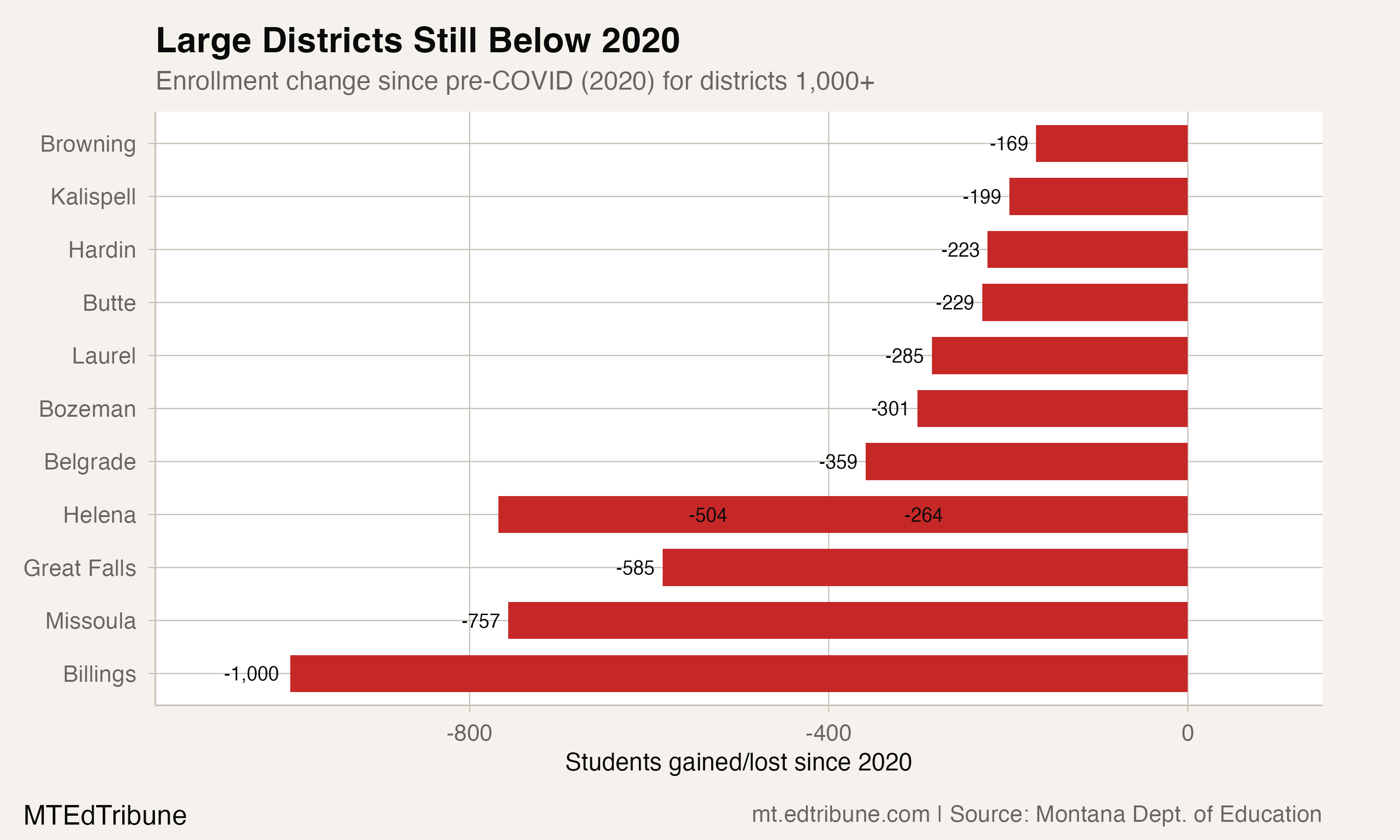
Billings Elem↗ET has lost 1,000 students since 2020, an 8.5% decline. Great Falls Elem↗ET is down 585 (8.1%). Helena Elem↗ET has dropped 504 (9.4%). Missoula Elem↗ET has lost 757 (13.2%), the steepest percentage decline among large districts. Belgrade Elem↗ET, in the booming Gallatin Valley, has fallen 14.4%.
The exceptions are mostly high school districts absorbing the delayed pipeline from years when elementary enrollment was higher. Bozeman H S↗ET gained 601 students since 2020 (26.8%). East Helena K-12↗ET, catching spillover from the capital, added 541 (38.7%). Missoula H S gained 239 (6.6%). These gains are real but finite: they reflect students who entered elementary during the growth era and are now aging into high school. The pipeline behind them is thinner.
Layered pressures
The trajectory gap is not just a COVID story. At least three forces are compounding the shortfall.
The most direct is demographic. Montana's school-age population dropped from 20% of the total population to 15% over three decades, according to Montana School Boards Association executive director Lance Melton. The trend has been a familiar challenge for smaller rural districts but has now become a significant issue in larger systems as well. Fewer children means fewer students regardless of what happens with school choice or migration.
Homeschooling has accelerated the shift. OPI's 2023-24 data showed 8,524 homeschooled students, up 9.3% in a single year. Combined with private school enrollment, 17,108 students attended non-public options, an increase of 403. Superintendent Arntzen attributed this partly to "parents that desire more engagement in their children's education through homeschooling."
Housing costs are a competing explanation in growth corridors. Missoula Superintendent Micah Hill connected the dots between housing and enrollment when discussing staff cuts: "Hard for me not to feel emotional about it," he said of families unable to afford the community. In Bozeman, where home prices more than doubled during the remote-work migration, Bozeman Elem↗ET has lost 301 students since 2020 even as Bozeman H S has surged. Young families priced out of the market do not enroll kindergartners.
The levy wall
School districts in Montana depend on voter-approved mill levies to fund operations beyond state minimums. As budgets tighten, these levies have become more necessary and harder to pass.
In 2006, Montana districts proposed 125 levies and all but five passed. By 2025, districts proposed roughly half that number and nearly half were voted down. Lance Melton, executive director of the Montana School Boards Association, told a legislative study commission: "We're down to a smidgeon here, we're down to the point of 'why are people running levies any more?'"
For districts already losing enrollment and the state funding attached to it, a failed levy compounds the problem. The margin for error shrinks each year.
What the gap cannot measure
The trajectory model assumes Montana would have kept growing at 1,200 students per year indefinitely. That was always unlikely. Birth rates were already falling before COVID. Some reversion was baked in. The gap overstates the loss to the extent that the pre-COVID trend itself was unsustainable.
But the model does not need to be exact to be useful. Even if the "true" trajectory was flat rather than growing, Montana would still be 7,110 students below its 2020 headcount of 149,181. The decline is real regardless of the counterfactual.
At the post-peak decline rate of roughly 2,834 students per year, Montana would fall below 140,000 by 2027 and below 136,000 by 2028. The 2025 Legislature doubled the quality educator payment and enacted what school advocates called the most significant education funding changes in three decades. Rex Weltz, the Helena superintendent who watched his district cut nearly 100 positions, now has a larger per-student allocation to work with. He has fewer students to apply it to every year.
Detailed code that reproduces the analysis and figures in this article is available exclusively to EdTribune subscribers.
Discussion
Sign in to join the discussion.
Loading comments...