Hawthorne Elementary, Helena's oldest school, was built in 1921 on Madison Avenue when the capital city's population was booming alongside the mining and railroad industries. In spring 2025, the school board debated closing it to save roughly $1 million a year. The alternative: eliminating music teachers, PE teachers, and school nurses at every elementary school in the district.
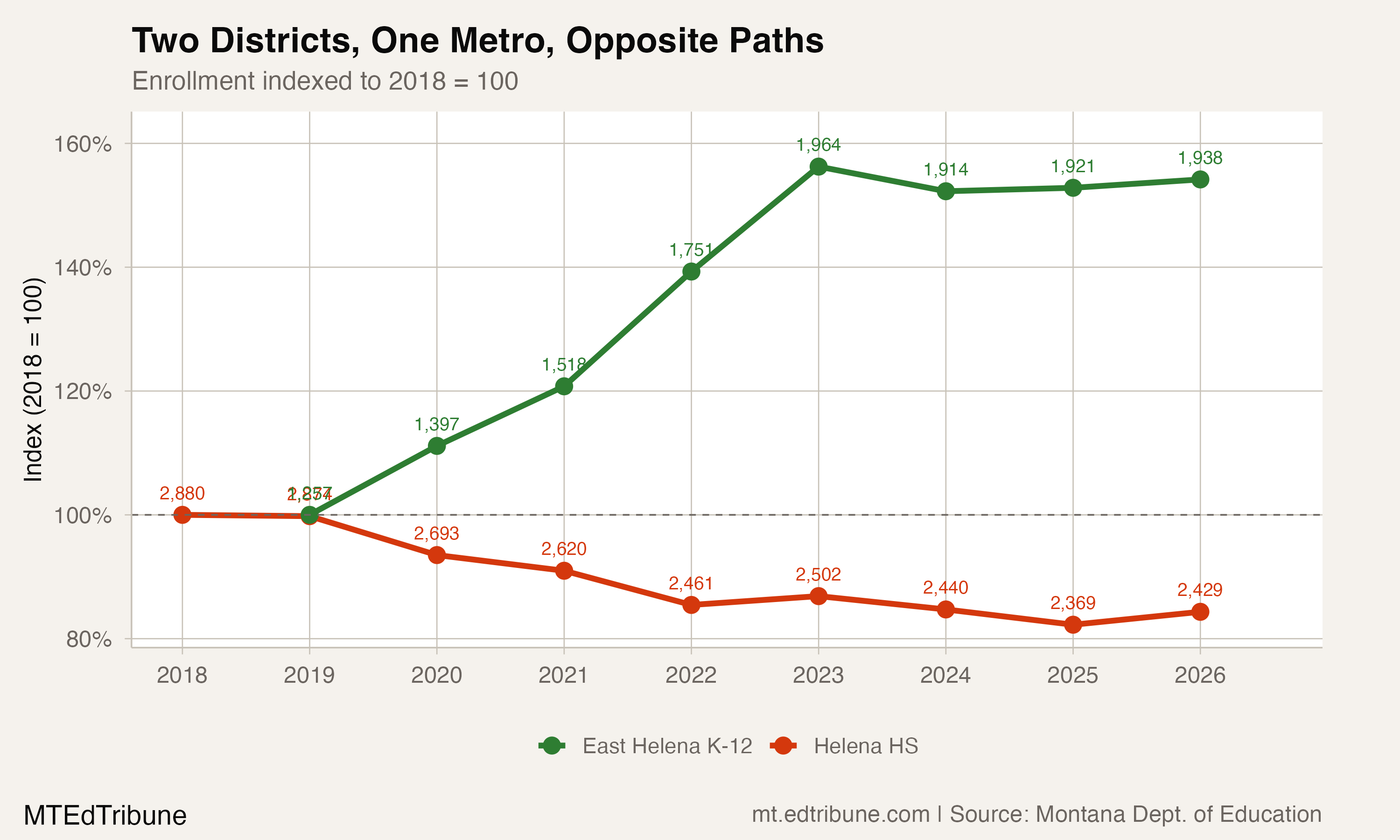
That is what enrollment decline looks like when it arrives at a school board agenda. Helena H S↗ET has lost 451 students since 2018, a 15.7% decline that represents the largest absolute loss of any high school district in Montana. Helena Elem↗ET hit its all-time low of 4,836 in 2026, down 9.4% from its 2020 peak of 5,340. Five miles east on Highway 12, East Helena K-12↗ET has surged 54.2% to 1,938 students since 2019, absorbing families from subdivisions that barely existed a decade ago.
The combined Helena area has not gained or lost much on net. The students did not disappear. They moved.
Five miles apart, opposite trajectories
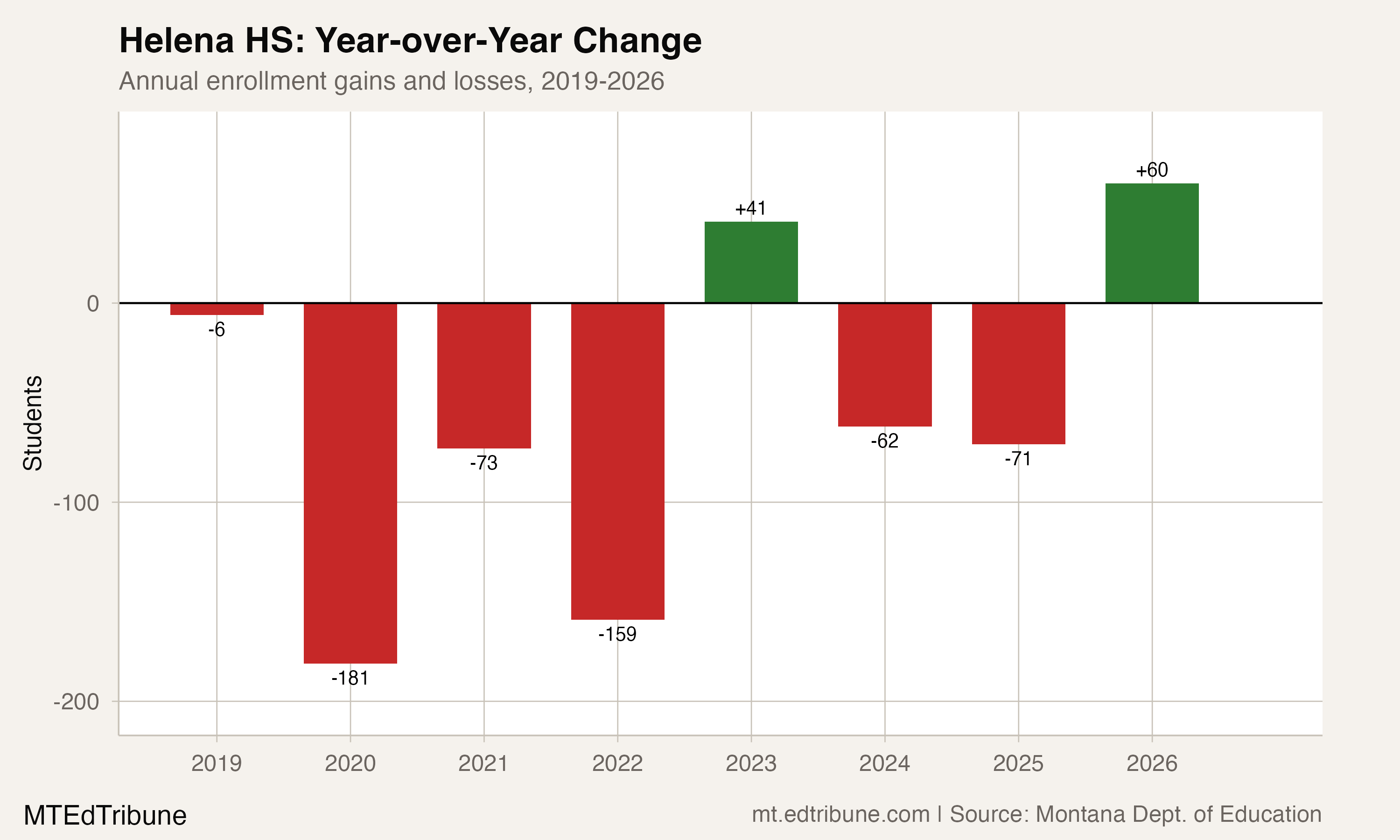
The divergence between Helena and East Helena is the sharpest suburban donut pattern in Montana. Helena HS peaked at 2,880 students in 2018 and has declined in six of the eight years since, reaching a low of 2,369 in 2025 before a modest bounce to 2,429 in 2026. The two years of gains, in 2023 (+41) and 2026 (+60), did not interrupt the overall trajectory: the district is still down 15.7% from its peak.
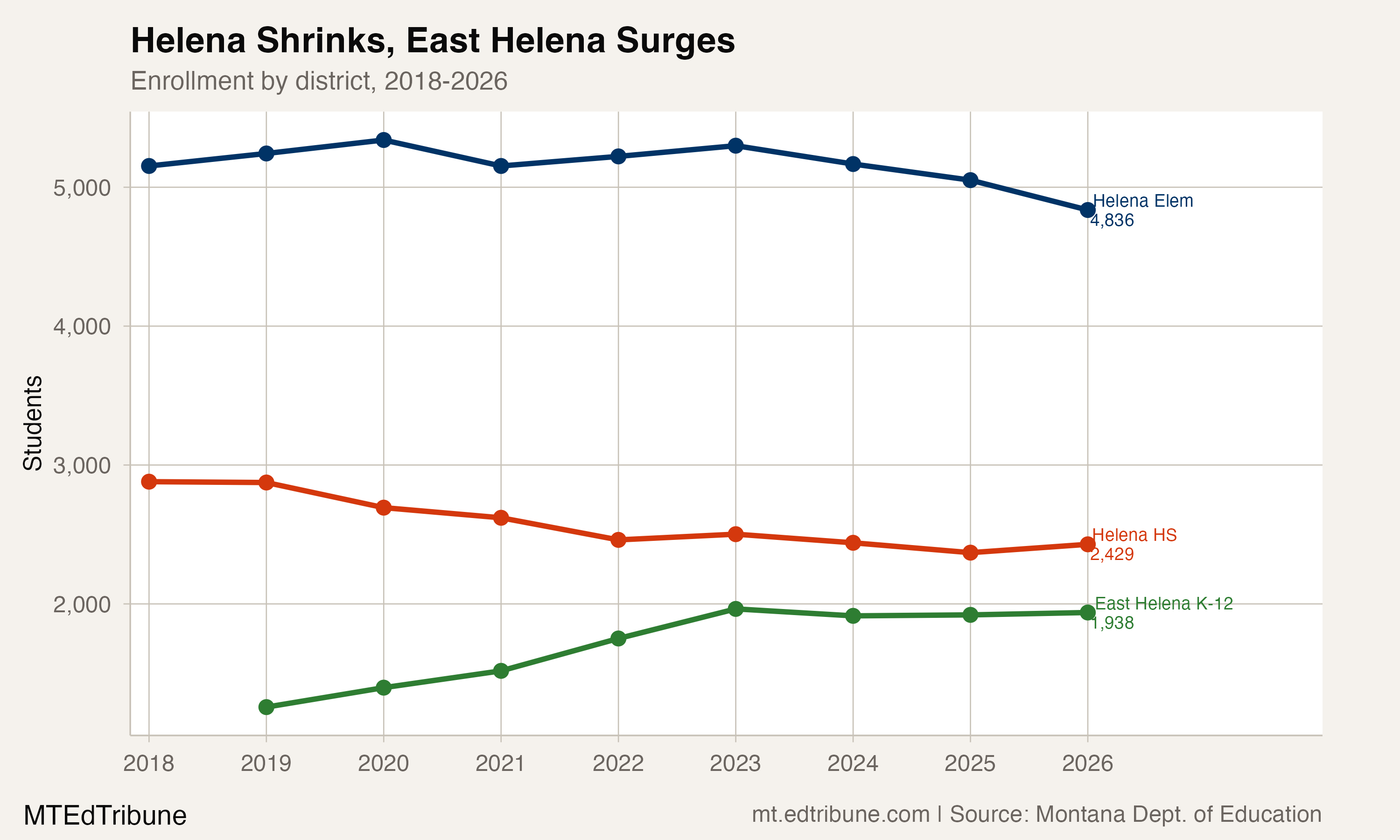
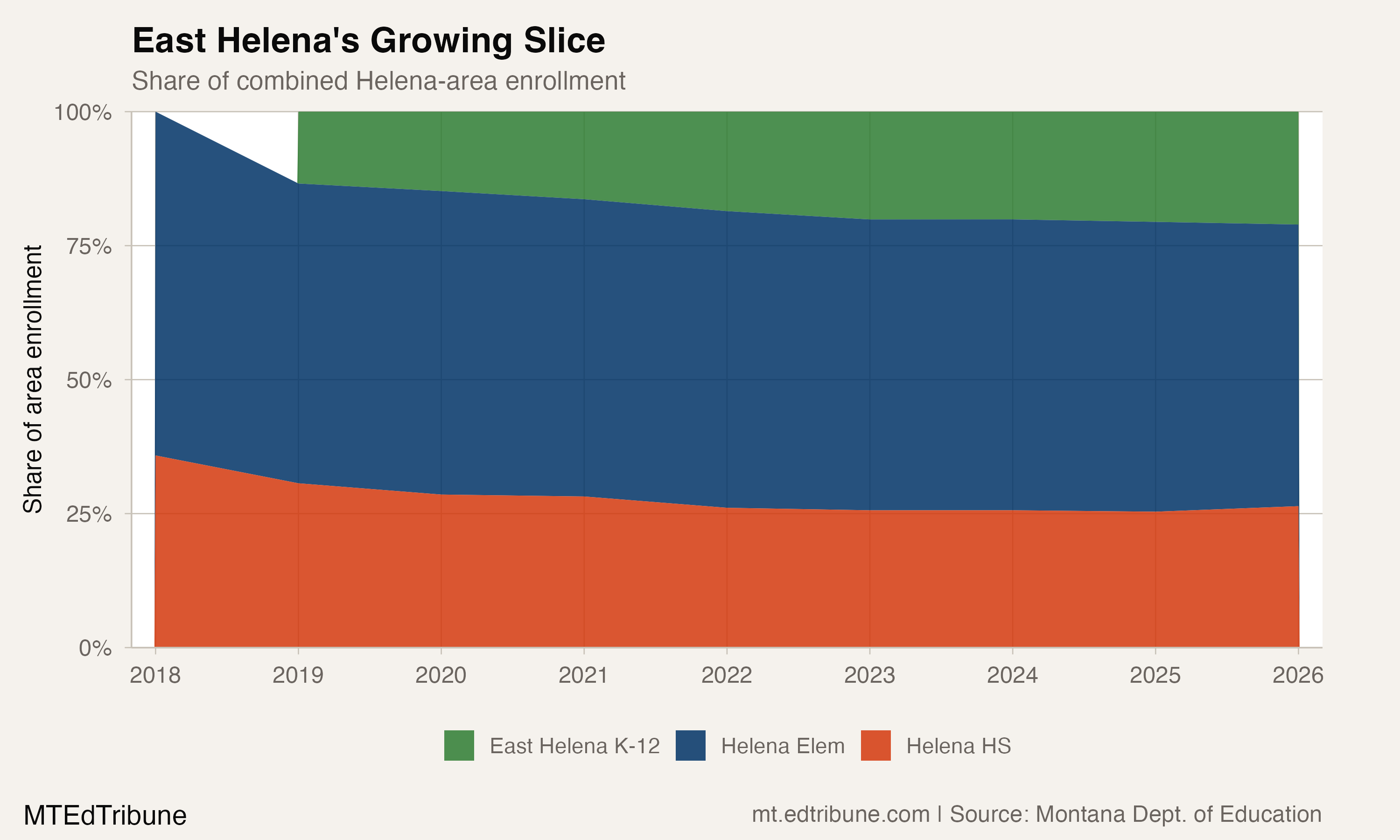
East Helena's growth came in two phases. From 2019 to 2023, the district added 707 students in four consecutive years of double-digit percentage growth. That boom slowed sharply after 2023: a small dip of 50 students in 2024, then near-flat growth of 7 and 17 in the two years since. The district's share of the combined Helena-area enrollment has grown from 13.4% to 21.1%, one of every five students in the capital region now attending schools in what was recently a small satellite community.
Helena Elem's decline accelerated in 2024-2026. The elementary district had actually grown through 2023, gaining 146 students from 2018 to reach 5,299. Then it lost 463 students in three years, erasing all prior growth and then some. The 2026 decline of 215 students was the district's worst single year in the dataset.
The budget arithmetic
Helena HS's 451 lost students translate to roughly $3.4 million in reduced state funding under Montana's Average Number Belonging (ANB) formula, which allocates a per-student entitlement amount that forms the core of each district's budget. Helena Elem's 317-student loss carries a similar penalty. Together, the two Helena districts have lost an estimated $5.8 million in ANB-driven revenue since 2018.
The consequences have been concrete. In May 2024, the board voted not to renew contracts for 52 non-tenured teachers, double the 26 cut the previous year. In June 2024, trustees eliminated 38 more positions to close a $2.5 million gap, including music and PE teachers at every elementary school and school nurses across the district.
"There's nothing left." -- Board member Jeff Hindoien, Helena Independent Record, June 2024
Hindoien's assessment reflected a district that had already cut through discretionary spending. The remaining choices all involved people: teachers, nurses, or entire buildings.
Why Helena and not Billings or Missoula
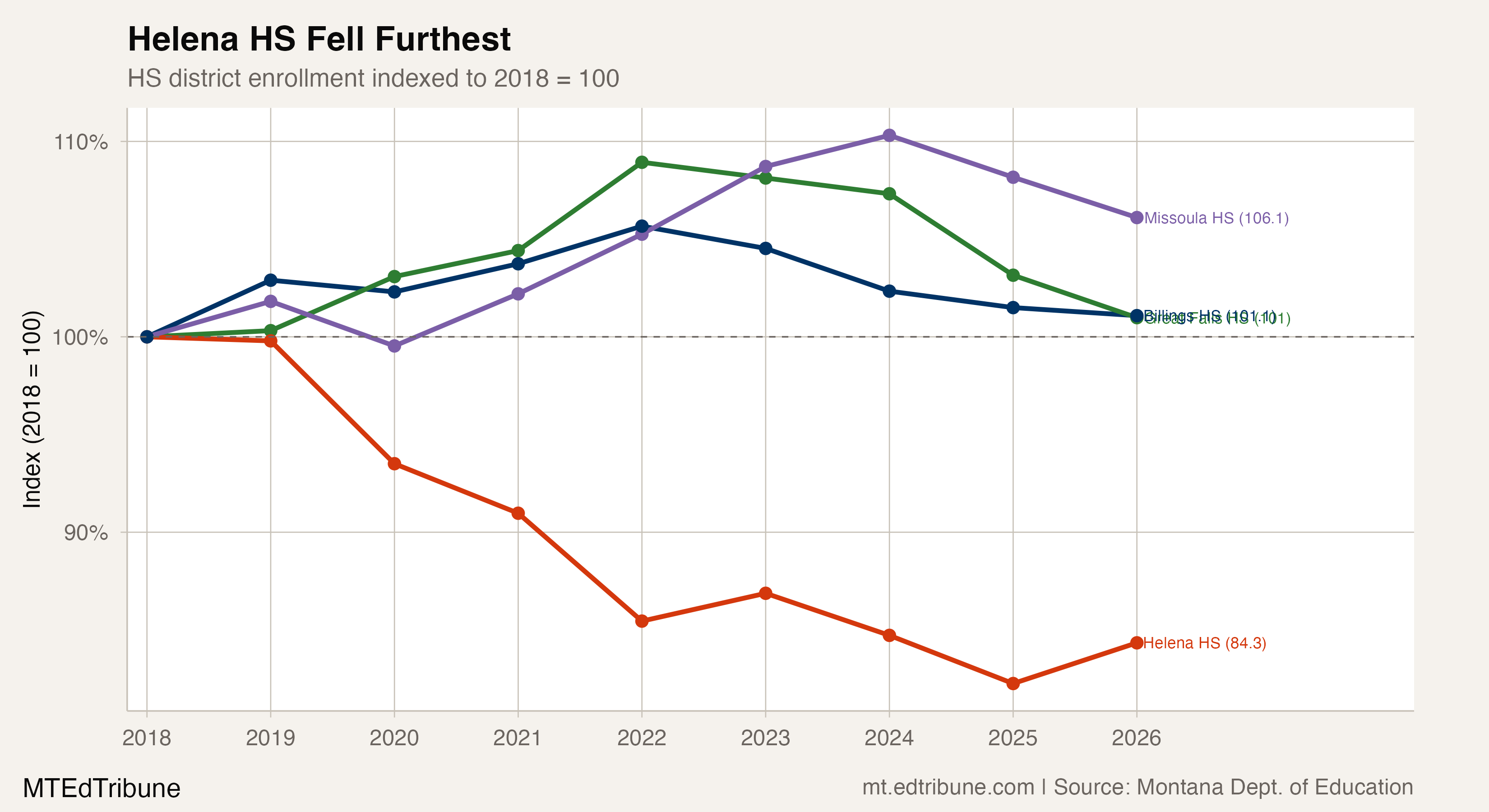
Helena HS's 15.7% decline stands apart from every other major Montana high school district. Indexed to 2018, Billings HS sits at 101.1, Great Falls HS at 101.0, and Missoula HS at 106.1. Helena HS sits at 84.3. No other metro high school district has fallen below 95.
Several factors contribute to the gap. Helena's housing affordability crisis has been particularly acute relative to wages. As the seat of state government, the capital city's economy runs on public-sector salaries that have not kept pace with housing costs driven partly by remote-work migration into western Montana. Families who might have bought in Helena's older neighborhoods now find equivalent or cheaper options in East Helena's new subdivisions.
East Helena's growth infrastructure tells the rest of the story. The city has 5,000-plus new homes in its development pipeline, a figure that stunned even local officials.
"Nobody even thought that East Helena was gonna grow, like there was no talk of growth. Certainly no talk of 5,000-plus homes of what we're facing now." -- Kevin Ore, East Helena Public Works Director, Montana Free Press, June 2025
The school district is already planning for the next wave. East Helena High School, with 585 students and a capacity of 700, is estimated to fill within six years.
The high school imbalance
Montana's split district structure, where communities operate separate elementary and high school districts, adds a layer of complexity. Helena Elem feeds students to Helena HS, but East Helena K-12 operates its own high school. Every family that moves from Helena to East Helena takes a student out of Helena's pipeline at both levels.
Within Helena HS, the two high schools have their own imbalance. Helena High School enrolled roughly 986 students compared to Capital High School's 1,307 in recent counts, a gap that led the district to propose boundary adjustments to equalize course offerings. Assistant Superintendent Josh McKay told the board that without changes, "students on one side of town will have more class opportunities than on the other side."
The enrollment disparity has compounded the budget crisis. Helena HS cut 11 high school teaching positions by increasing the number of daily classes each teacher handles. With fewer students spread unevenly across two buildings, the district faces the structural inefficiency of maintaining two comprehensive high schools that were designed for a larger student body.
A demographic shift underneath the headline
The enrollment losses in Helena are not distributed evenly across racial groups. Helena HS's white enrollment fell 16.4%, from 2,489 to 2,082, accounting for 90% of the district's total loss. Helena Elem saw an even starker divergence: white students declined 10.5% (4,466 to 3,999) while Hispanic enrollment more than doubled from 195 to 402. Black enrollment nearly doubled as well, from 32 to 62.
East Helena's growth is predominantly white. The district added 525 white students (a 48.4% increase from 2019 to 2026), but also saw Hispanic enrollment more than double from 57 to 127. The suburban ring is absorbing a disproportionate share of the capital region's white families, while Helena proper is becoming modestly more diverse even as it shrinks.
What Helena's $283 million question reveals
In September 2025, Helena voters faced a $283 million bond proposal: $240 million to rebuild Helena High School and upgrade Capital High, plus $43 million for a new Kessler Elementary. The district argued that construction costs had risen 63% since 2018, from $276 to $450 per square foot, and that delaying to 2030 would push costs another 40% higher.
The bond proposal captured the fundamental tension facing a declining district. Helena needs modern facilities to compete with East Helena's newer schools and attract families, but the enrollment trajectory makes it harder to justify the investment. A $300,000 home would pay an additional $220 per year for 30 years under the high school bond.
What the data shows and what it cannot
The enrollment numbers establish that students are redistributing within the Helena metro area, not vanishing from the region entirely. Montana does not track inter-district transfer reasons, and Lewis and Clark County does not publish school-age population estimates at the sub-county level. The data cannot separate housing-cost movers from facility-quality movers from families who would have left regardless.
What the data does show: East Helena's growth has slowed markedly since its 2023 peak, while Helena Elem's decline has accelerated. If the elementary pipeline is the leading indicator, Helena HS's two years of modest gains in 2023 and 2026 may prove to be temporary pauses. The district's proposed boundary changes, building investments, and staffing decisions over the next two years will all be made with fewer students funding each choice.
Enrollment counts and demographic breakdowns come from the Montana Office of Public Instruction and cover 2018 through 2026 for Helena H S, Helena Elem, and East Helena K-12. Budget and bond figures are attributed to Montana Free Press and the Helena Independent Record.
Detailed code that reproduces the analysis and figures in this article is available exclusively to EdTribune subscribers.
Discussion
Sign in to join the discussion.
Loading comments...