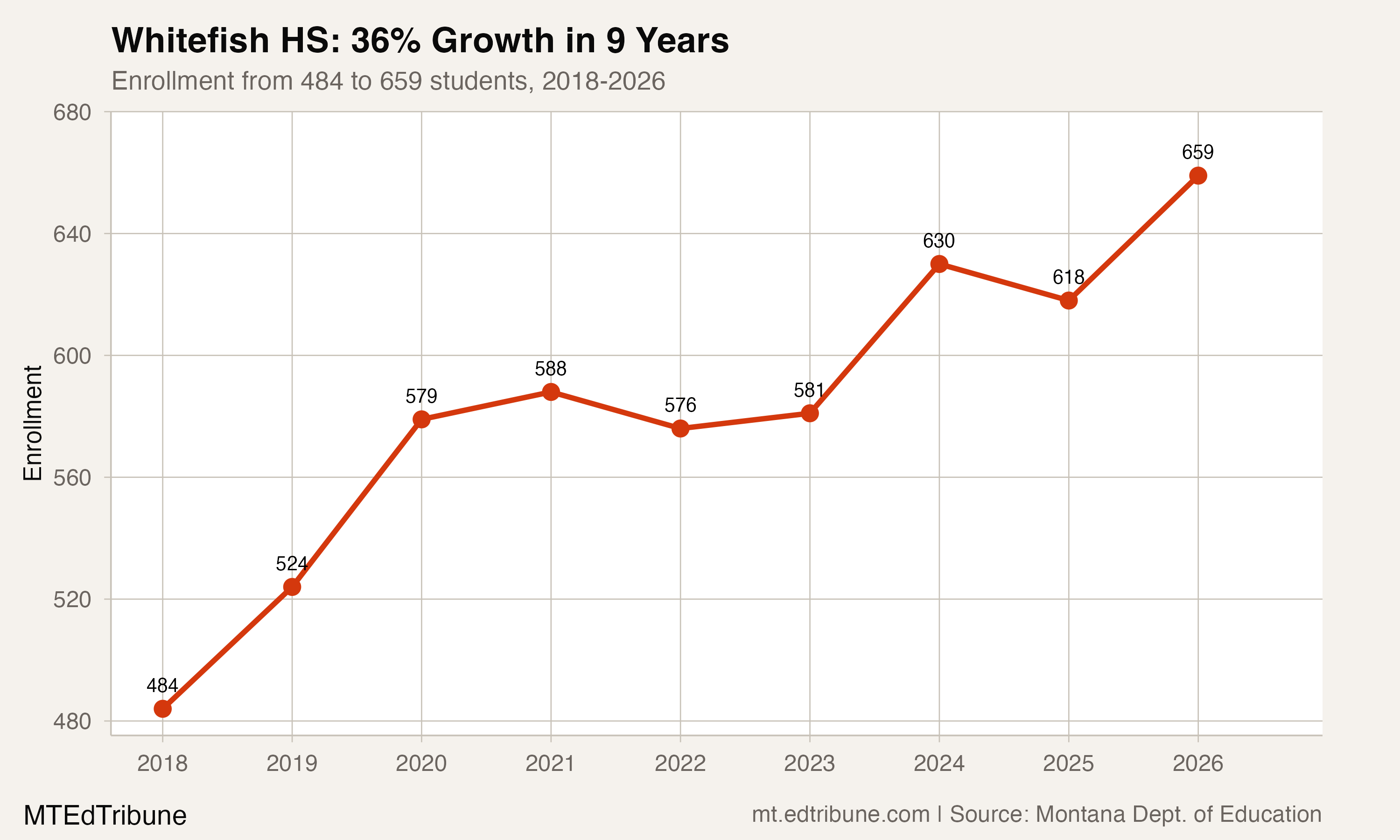
In September 2024, Whitefish voters approved a $26.5 million bond to expand their high school. A year earlier, voters had rejected a $33.7 million version by 152 votes. What changed was not the argument but the evidence: Whitefish H S↗ET had grown from 484 students to 630 in six years, and the building was running out of rooms.
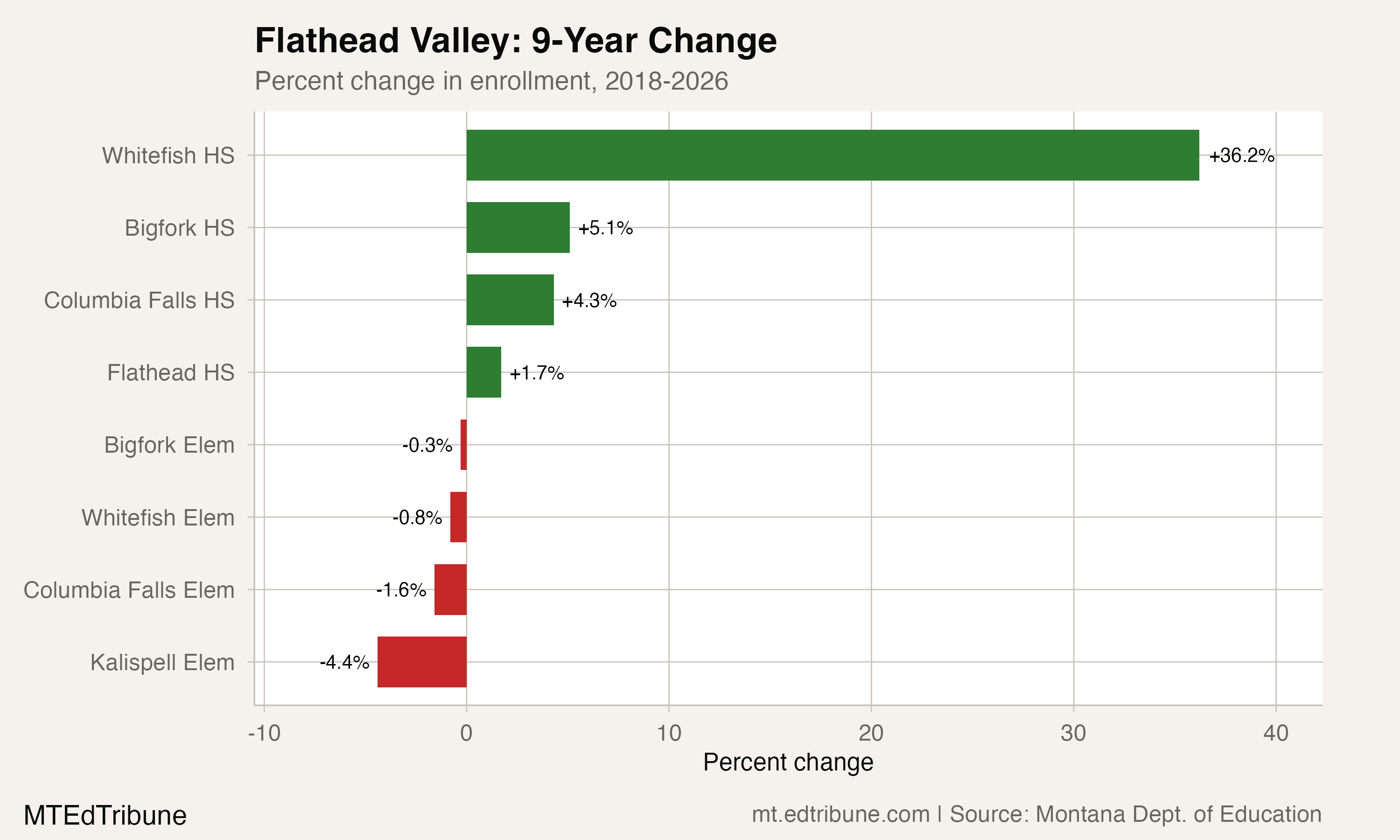
That growth has not stopped. Whitefish HS enrolled 659 students in 2025-26, up 36.2% from 2018. Across the same nine years, every elementary district in the Flathead Valley lost students. The valley's four high school districts collectively grew 6.2%. Its four elementary districts collectively shrank 2.6%. The same communities are producing opposite enrollment signals depending on which end of the building you walk into.
The split in one chart
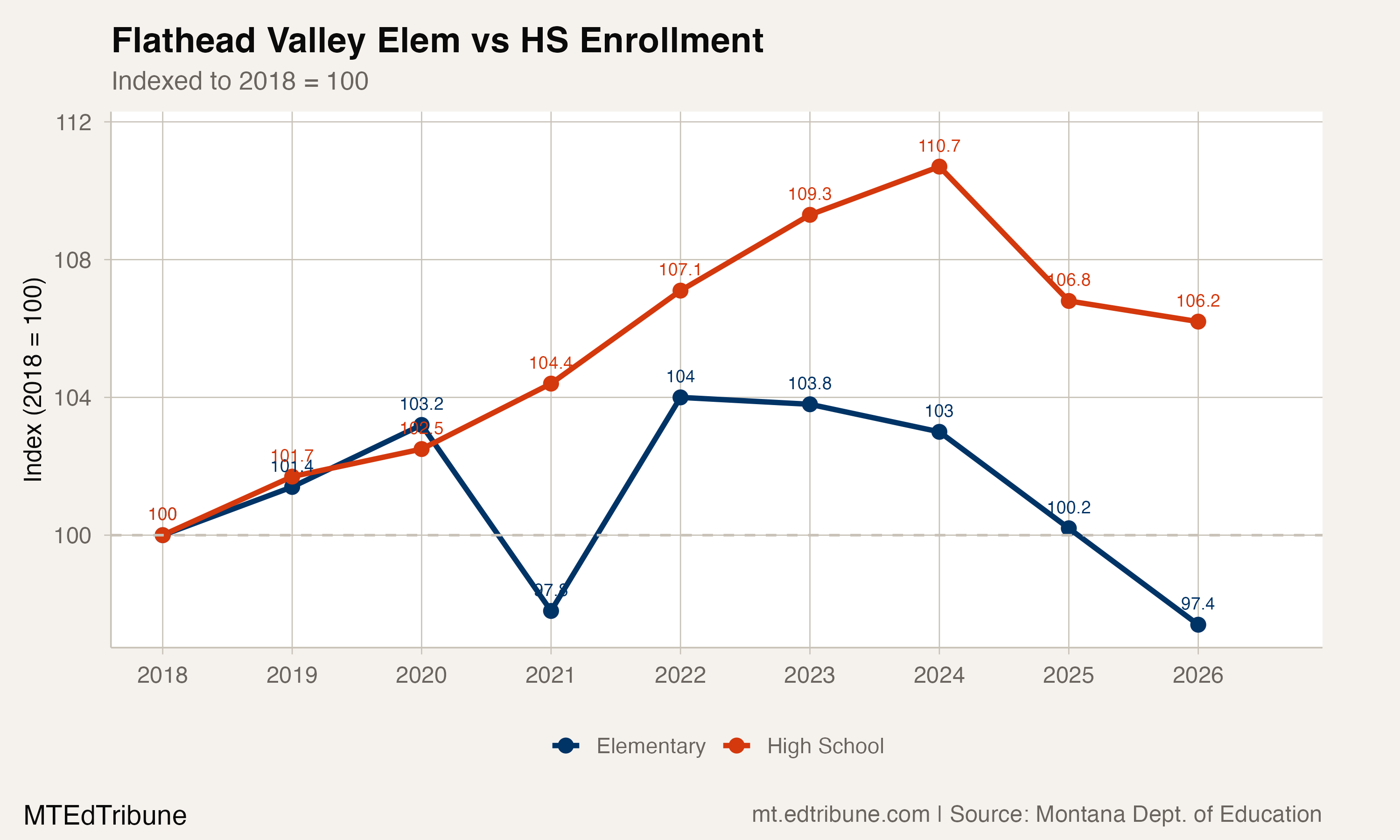
The indexed trendlines make the gap visible. High school enrollment across the valley climbed steadily through 2024, peaking at 110.7% of 2018 levels before a modest pullback. Elementary enrollment bounced around its baseline, peaked in 2022, then fell to 97.4% of 2018 levels by 2026. The result: a nearly 9-point spread between the two sectors that did not exist nine years ago.
The pattern holds across all four communities. Bigfork H S↗ET grew 5.1% while Bigfork Elem↗ET shrank 0.3%. Columbia Falls H S↗ET grew 4.3% while Columbia Falls Elem↗ET fell 1.6%. In every case, the high school outperformed the elementary.
Whitefish HS is the outlier's outlier
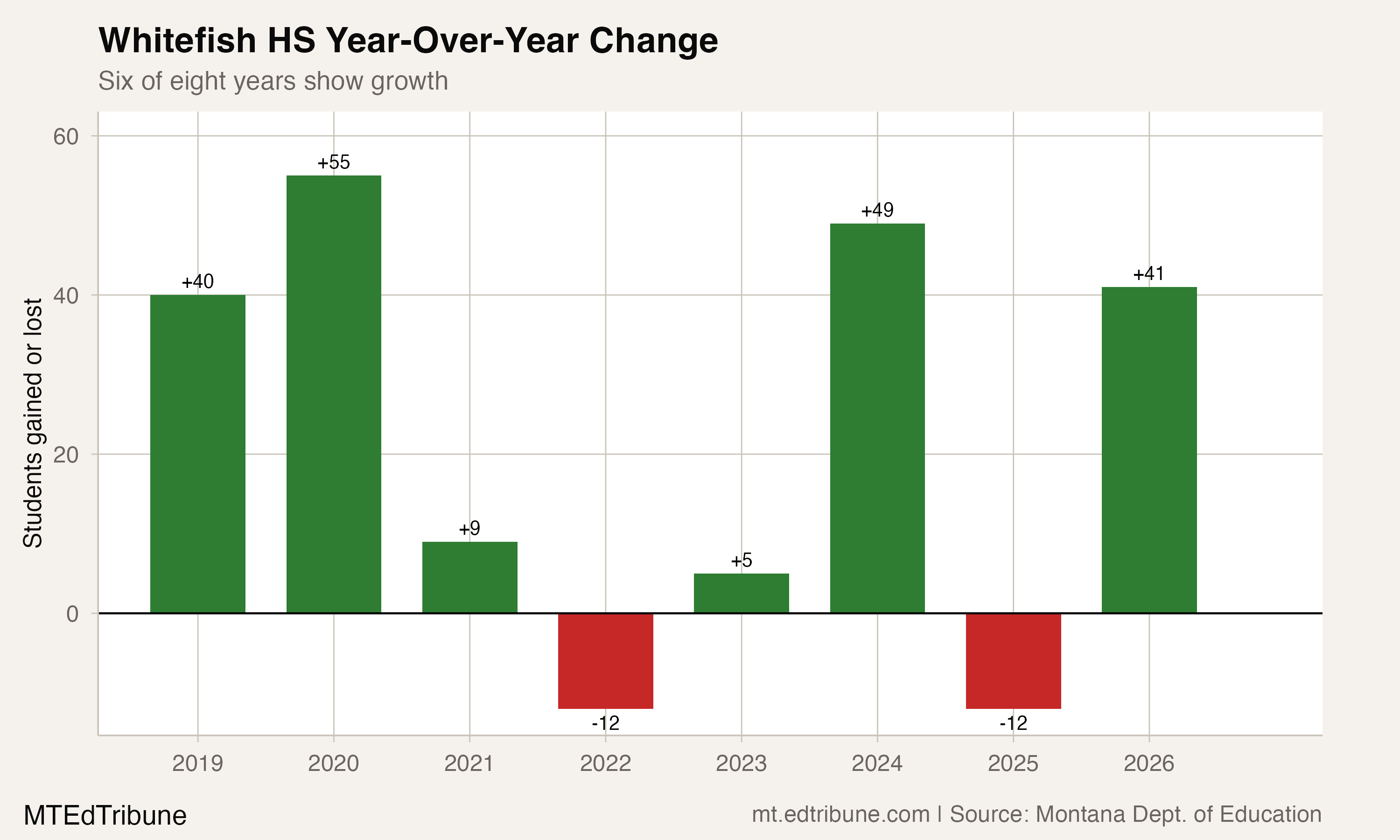
The valley-wide split is notable. What makes the Flathead story distinct is the scale of the Whitefish HS surge. Its 36.2% growth dwarfs the next-fastest valley high school, Bigfork HS, at 5.1%. Whitefish HS grew in six of eight year-over-year transitions, adding 40 students in 2019, 55 in 2020, and 49 in 2024. Even its two down years, 2022 and 2025, were small dips of 12 students each, immediately followed by rebounds.
Whitefish HS now accounts for 14.4% of all valley high school enrollment, up from 11.2% in 2018. That share gain came primarily at the expense of Flathead H S↗ET, the Kalispell-based district and the valley's largest high school at 2,944 students. Flathead HS grew 1.7% over nine years, a pace that feels stagnant next to Whitefish's trajectory.
Meanwhile, Whitefish Elem↗ET declined 0.8% over the same period, from 1,269 to 1,259 students. The same community that needs to build high school classrooms is watching elementary enrollment drift down. Whitefish's business clerk Lucie Shea told the Whitefish Pilot what the data makes plain: "We know the high school and middle school enrollments are through the roof. But the elementary is lower."
Who is filling those high school seats
The most likely explanation is demographic composition, not net population growth. Whitefish's population grew from 7,751 to 9,256 between 2020 and 2024, according to Census estimates, yet overall school enrollment stayed flat. The share of residents under 18 held steady at 17.2% in both years. The new residents are not disproportionately families with young children. They appear to be families with older children, or households whose children age into high school while fewer young families move in behind them.
Housing costs are the structural filter. The National Association of Realtors ranked Montana the least affordable state in 2024 based on home prices relative to local incomes. Kalispell Chamber president Lorraine Clarno put it bluntly: "We still have a huge affordability issue in our community, there's no ifs ands or buts." The Flathead Valley sits at the center of this crisis. National Park counties saw the steepest pandemic-era price appreciation, and Flathead, which borders Glacier National Park, was no exception.
The affordability filter works asymmetrically by age. A family that bought a home in 2015 with a kindergartner now has a sophomore. They can afford to stay. A young couple with a toddler, priced out by a median sale price of $530,000 in Kalispell and $975,000 in Whitefish, either rents, moves to a cheaper county, or delays having children. The high school fills with the children who arrived a decade ago. The elementary empties because their replacements cannot afford to come.
Kalispell is feeling it first
Kalispell Elem↗ET, the valley's largest elementary district at 2,921 students, has absorbed the steepest losses: 133 students since 2018, a 4.4% decline. The trajectory has accelerated. After bouncing back to a nine-year high of 3,147 in 2022, Kalispell Elem has lost students in four consecutive years, dropping 226 since that peak.
The fiscal math is unforgiving. Montana funds schools through a per-student formula called ANB (average number belonging), paying roughly $4,900 per elementary student and $6,300 per high school student. Every elementary student who does not materialize costs Kalispell about $4,900, but the six elementary buildings and the middle school still need heat, maintenance, and teachers. By late 2024, Kalispell Public Schools faced a $2.7 million deficit across its elementary and high school divisions, with plans to eliminate the equivalent of 39.35 full-time positions.
"School funding is a challenge for every district. We're all nickel-and-diming every single penny in our budget to make it work. Teacher salaries, even though we increased them this year, are still nowhere where they need to be." -- Trevor Dahlman, Olney-Bissell superintendent, Flathead Beacon, Dec. 2025
Dahlman runs a 96-student district, not a major system. But his candor reflects a valley-wide reality: Kalispell's elementary levy last passed in 2007, and voters have rejected high school levies in 2022, 2023, and 2024. Kalispell operates as the lowest-funded Class AA high school district in Montana, according to its finance director.
Two versions of the same valley
The Flathead's enrollment split is not unique in Montana. Bozeman's high school district has grown 31.8% over nine years while Gallatin County elementaries stagnate. The mechanism is the same: a housing market that selects for established families over new arrivals. But the Flathead version is sharper because Whitefish HS is small enough that the percentage gains are outsized, and because Kalispell's budget distress is already producing layoffs rather than just projections.
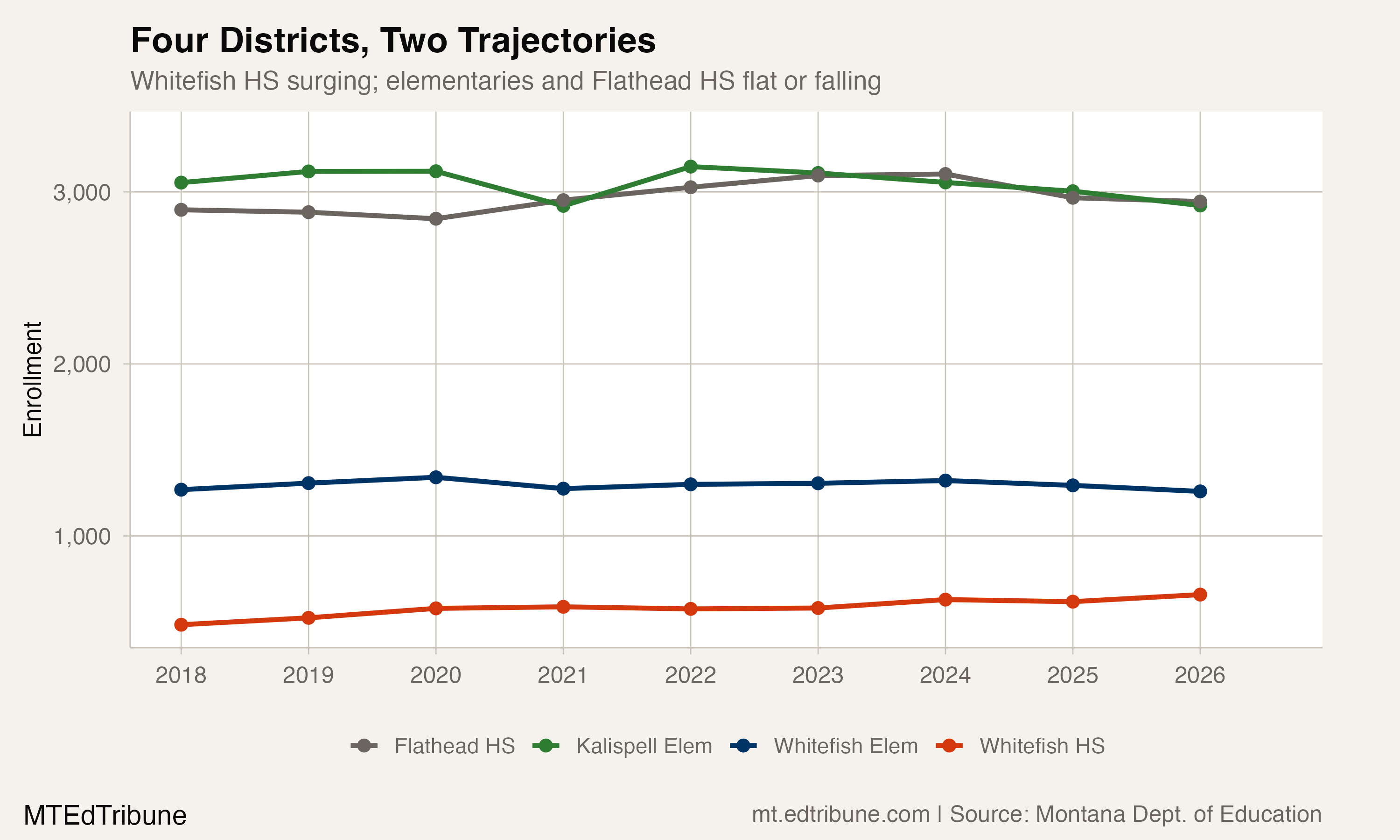
The four-district comparison makes the divergence visual. Kalispell Elem and Flathead HS, the two large districts, track each other closely around the 3,000-student mark. Whitefish Elem hovers near 1,270. Whitefish HS climbs steadily from 484 toward 660, converging on a scale that would have seemed implausible a decade ago.
Montana's decennial education funding formula review, currently underway through the School Funding Interim Commission, will determine whether the ANB formula adapts to communities where the students are aging faster than they are arriving. Whitefish broke ground on its high school expansion in March 2026, betting on continued growth through the end of the decade. Twenty miles south, Kalispell is cutting positions and hoping voters will finally approve a levy. Same valley, same housing market, opposite enrollment pressures, and a funding formula that treats each district as if it exists in isolation.
Detailed code that reproduces the analysis and figures in this article is available exclusively to EdTribune subscribers.
Discussion
Sign in to join the discussion.
Loading comments...