Correction (July 23, 2026): An earlier version said East Helena High School had 585 students. Its current enrollment is 543.
Superintendent Dan Rispens told the Boulder Monitor in late 2024 that the district was buying buses. Not replacing old ones. Adding routes. East Helena K-12↗ET had gone from four bus routes in 2001 to 10, and the newest subdivisions on the east side of town were still filling. The district's oldest bus, a 1989 model with nearly a million miles on it, was finally retired. The fleet needed to grow because the student body would not stop growing.
Since its reorganization into a K-12 district in 2019, East Helena has added 681 students, a 54.2% gain that makes it Montana's fastest-growing district among those enrolling more than 1,000 students. In a state that has lost 8,502 students since its 2023 peak, East Helena's trajectory is an outlier so sharp that it bends the capital region's enrollment math. One of every five students in the Helena metro area now attends school in what was, a decade ago, a small satellite community built around a shuttered lead smelter.
From Superfund to subdivisions
East Helena's growth story starts underground. The American Smelting and Refining Company operated a lead smelter on the east edge of town from 1888 to 2001, processing 70,000 tons of lead bullion a year. In 1984, the EPA declared the site a Superfund cleanup zone. For two decades, East Helena was defined by contamination, not opportunity.
That began to change when the Montana Environmental Trust Group took control of 2,048 acres of former ASARCO land in 2009 and began remediation and redevelopment. Nearly 15 years of cleanup reduced arsenic and selenium concentrations in groundwater by more than 50%. The land that families once avoided became the land they could afford.
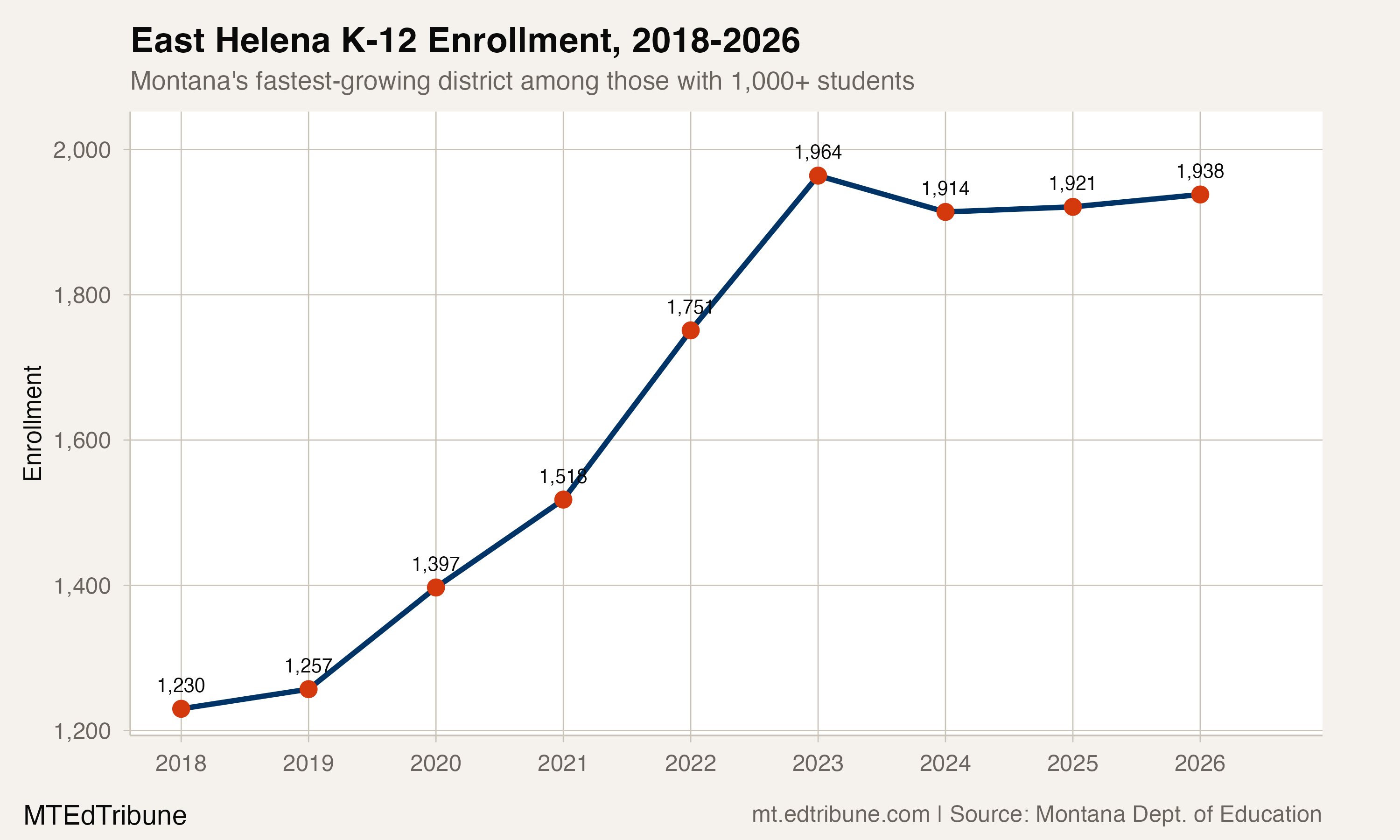
The enrollment curve tracks the construction timeline. East Helena added just 27 students in 2019, then 140 in 2020 as the first wave of new subdivisions delivered homes. The boom accelerated: 121 students in 2021, 233 in 2022, 213 in 2023. At its peak growth rate in 2022, the district expanded 15.3% in a single year.
Then the pace broke. East Helena lost 50 students in 2024, its first decline in the dataset. Growth resumed in 2025 and 2026, but at a fraction of the boom years: seven and 17 students, respectively. The district appears to have hit a plateau near 1,940 students.
The boom, the dip, and what they signal
The year-over-year pattern tells a more textured story than the headline growth rate.
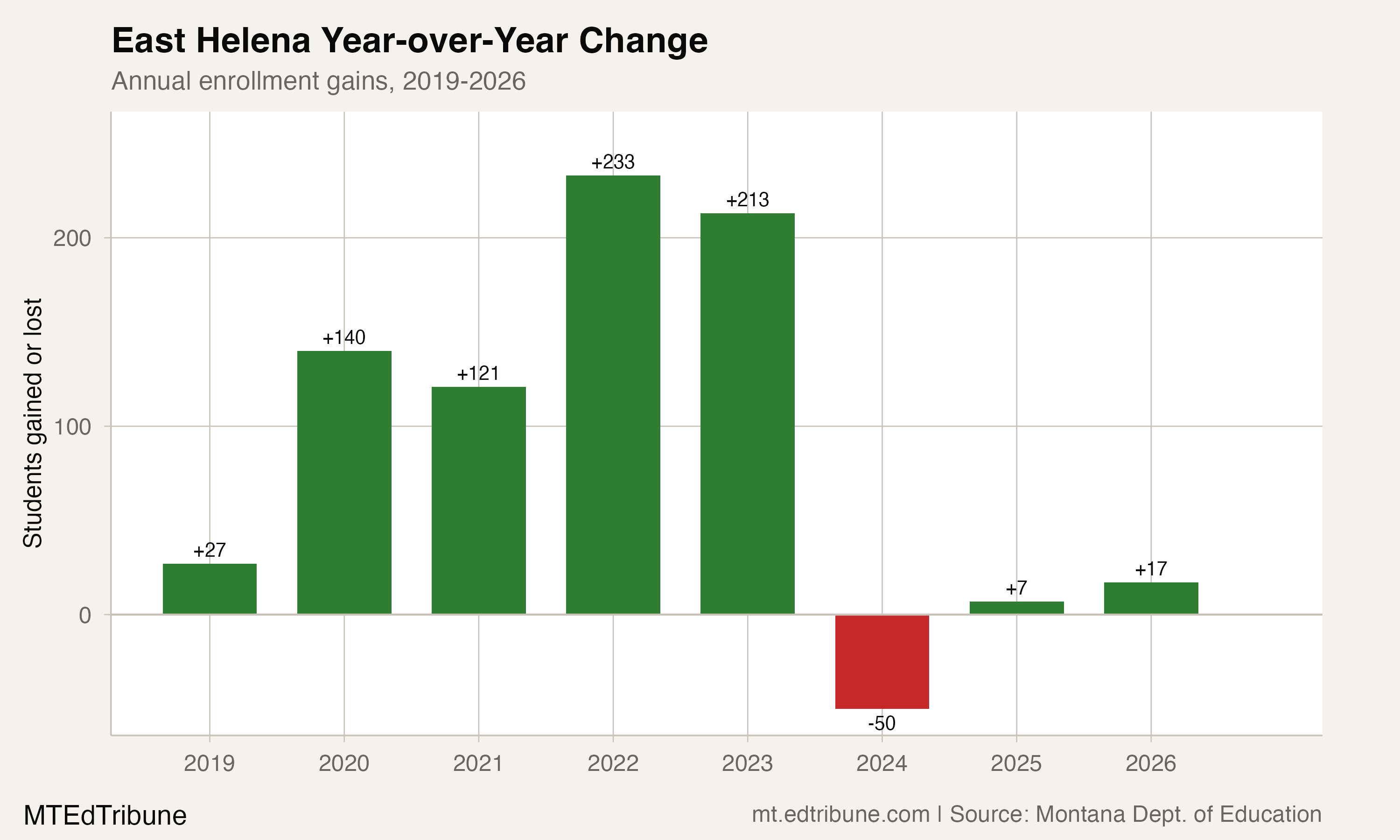
The four-year boom from 2020 through 2023 added 707 students, an average of 177 per year. That growth corresponded with the buildout of Highland Meadows and other subdivisions on remediated ASARCO land. The 2024 dip of 50 students coincided with a statewide decline of 1,988, suggesting East Helena was not immune to the broader enrollment contraction even as housing continued to be built.
The subsequent gains of seven and 17 students represent organic stabilization, not resumed boom. East Helena's 2026 enrollment of 1,938 sits 26 students below its 2023 peak of 1,964. The district is growing, but the period of triple-digit annual gains appears to have closed.
Whether it reopens depends on water. East Helena's most ambitious housing projects are stalled because the state denied the city's request for water rights on former smelter lands. Habitat for Humanity's 1,500-home Rose Hills development and a separate 4,500-home project both require water infrastructure that does not yet exist. METG President Cynthia Brooks warned that "the city of East Helena needs those water rights to achieve the housing goals for its property."
If those 6,000 homes are built over the next 10 to 20 years, the school district will need to grow accordingly. If they are not, the plateau may be permanent.
The capital region's redistribution
East Helena's growth has not happened in isolation. It has happened at Helena's expense.
Helena Elem↗ET peaked at 5,340 students in 2020 and has since fallen to 4,836, an all-time low. Helena H S↗ET peaked at 2,880 in 2018 and sits at 2,429, a 15.7% decline. Together, the two Helena districts lost 955 students from their respective peaks while East Helena gained 681 from its 2019 baseline.
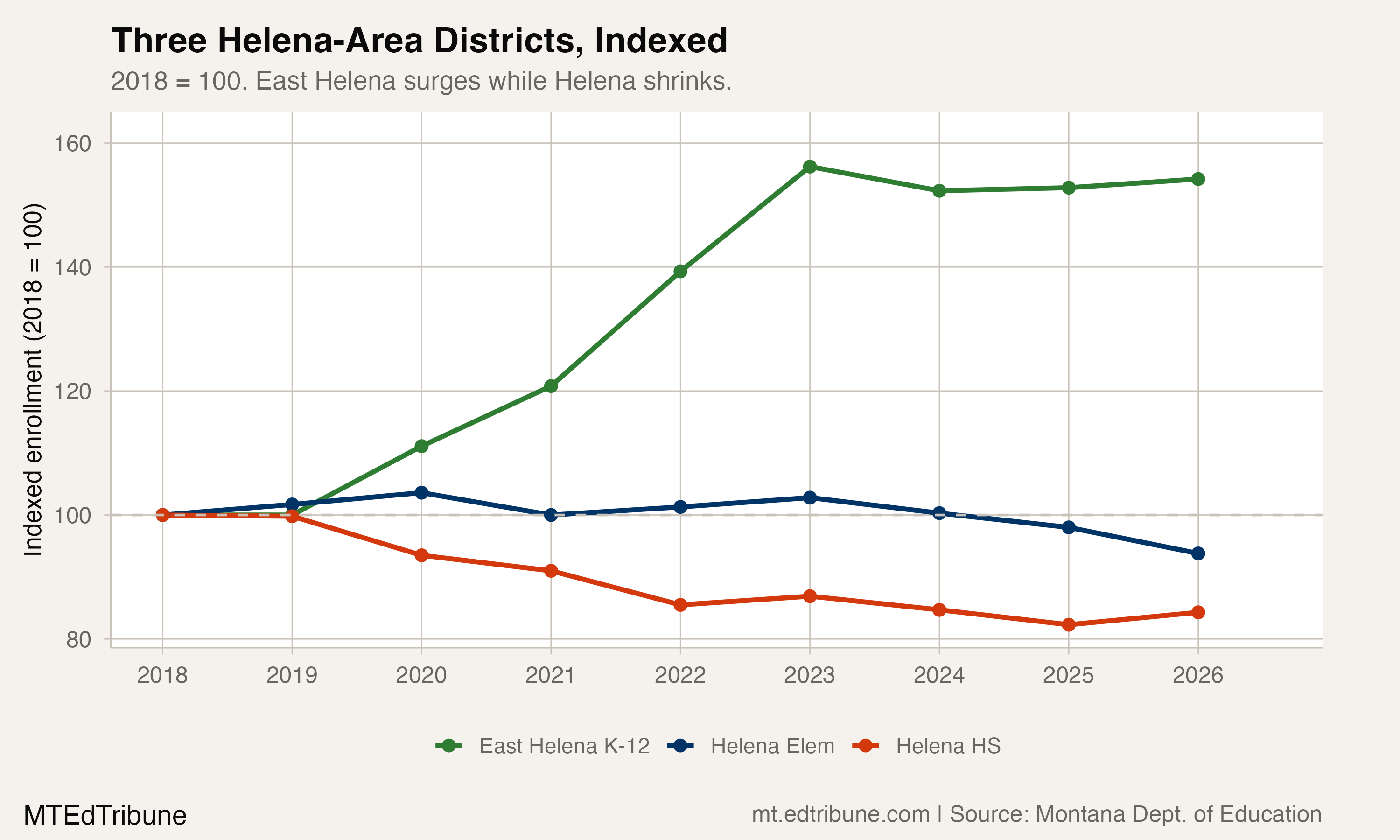
The combined Helena metro area, all three districts together, enrolled 9,263 students in 2018 and 9,203 in 2026. The region lost 60 students on net in eight years. The headline is not a disappearance. It is a redistribution.
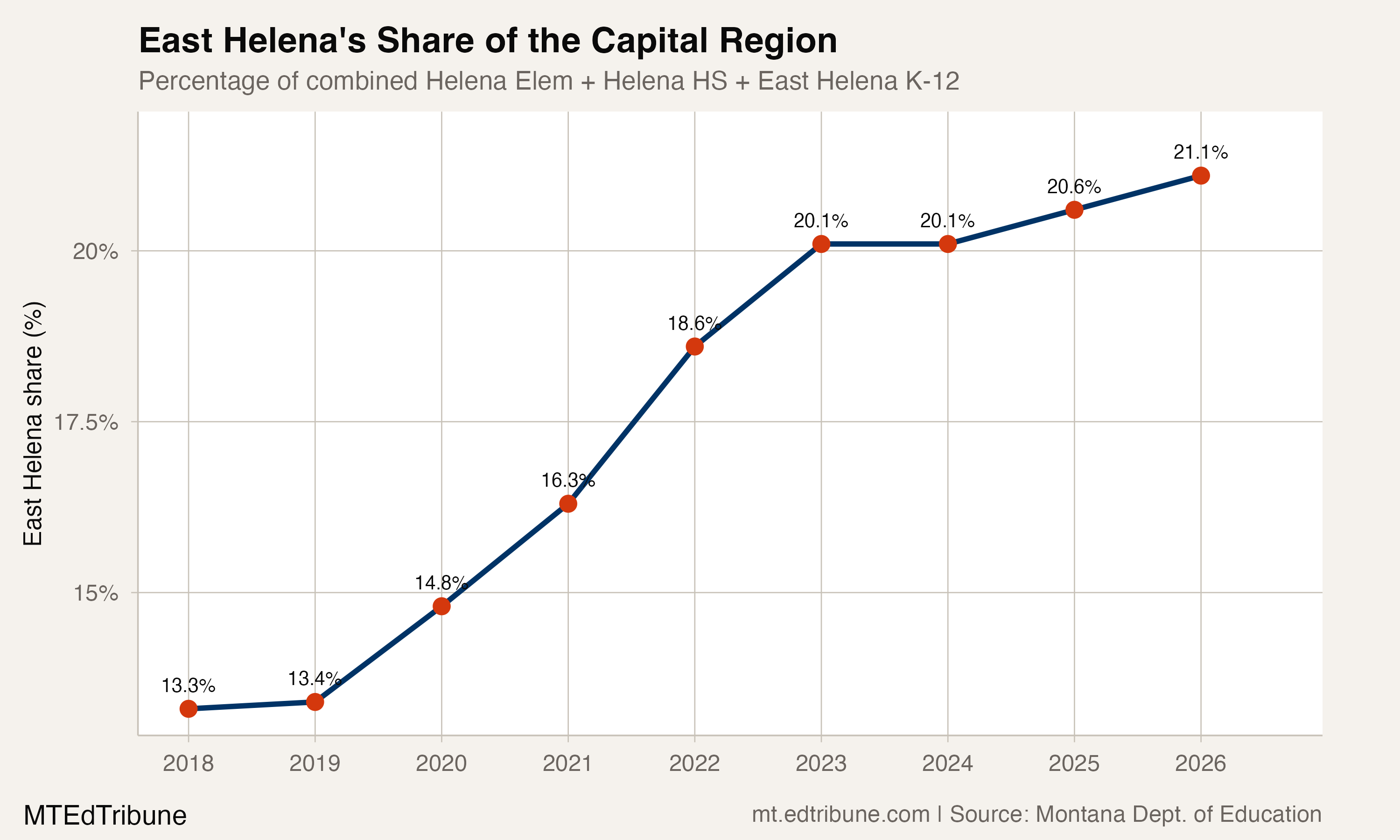
East Helena's share of that combined total has grown from 13.3% to 21.1%, nearly doubling its proportion of the capital region's students. In 2018, East Helena was a small elementary district accounting for 13.3% of Helena-area students. By 2026, it is a K-12 district enrolling more than one in five.
The mechanism is housing cost. Lewis and Clark County's median home value reached $389,000 as of early 2024, a 68% increase since 2020. Monthly housing costs on a median-priced Montana home more than doubled over that period while per-capita income grew only 26%. East Helena's new subdivisions have offered homes in the $200,000 to $300,000 range, a price point that has largely vanished from Helena proper.
"Nobody even thought that East Helena was gonna grow, like there was no talk of growth. Certainly no talk of 5,000-plus homes of what we're facing now." -- Kevin Ore, East Helena Public Works Director, Montana Free Press, June 2025
Planning five to 10 years ahead
Superintendent Rispens has framed the challenge as a timing problem. In a 2022 interview with the Helena Independent Record, he said the district needs to be "five to ten years ahead" of growth because securing funding and completing construction takes years. As of October 2022, the district operated five schools with a combined capacity of 2,250 students and enrollment of 1,680.
By 2026, enrollment has reached 1,938 across those same five schools. Eastgate Elementary handles pre-K and kindergarten, Prickly Pear Elementary serves grades one and two, Radley Elementary takes grades three through five, East Valley Middle School covers grades six through eight, and East Helena High School serves grades nine through 12. Classrooms are filling. A Boulder Monitor report noted that teachers across all five buildings report larger class sizes than in previous years, and the high school already has a floating teacher who instructs in other classrooms during planning periods.
East Helena High School, with 543 students and a capacity of 700, is the facility projected to fill first, in roughly six to seven years. Voters passed a $12 million bond to build a new school for first and second graders, and the board holds vacant land for future school construction. The district's 2024 Facility Master Plan, drafted with SMA Architects, lays out options including an additional wing for East Valley Middle School and potential restructuring of grade configurations across existing buildings.
The peer comparison
Among Montana's 405 districts tracked over the full data period, 168 grew. East Helena's 54.2% gain places it second among districts with 500 or more students, trailing only Powell County HS, whose 169.4% jump reflects a consolidation that absorbed students from neighboring districts rather than organic growth.
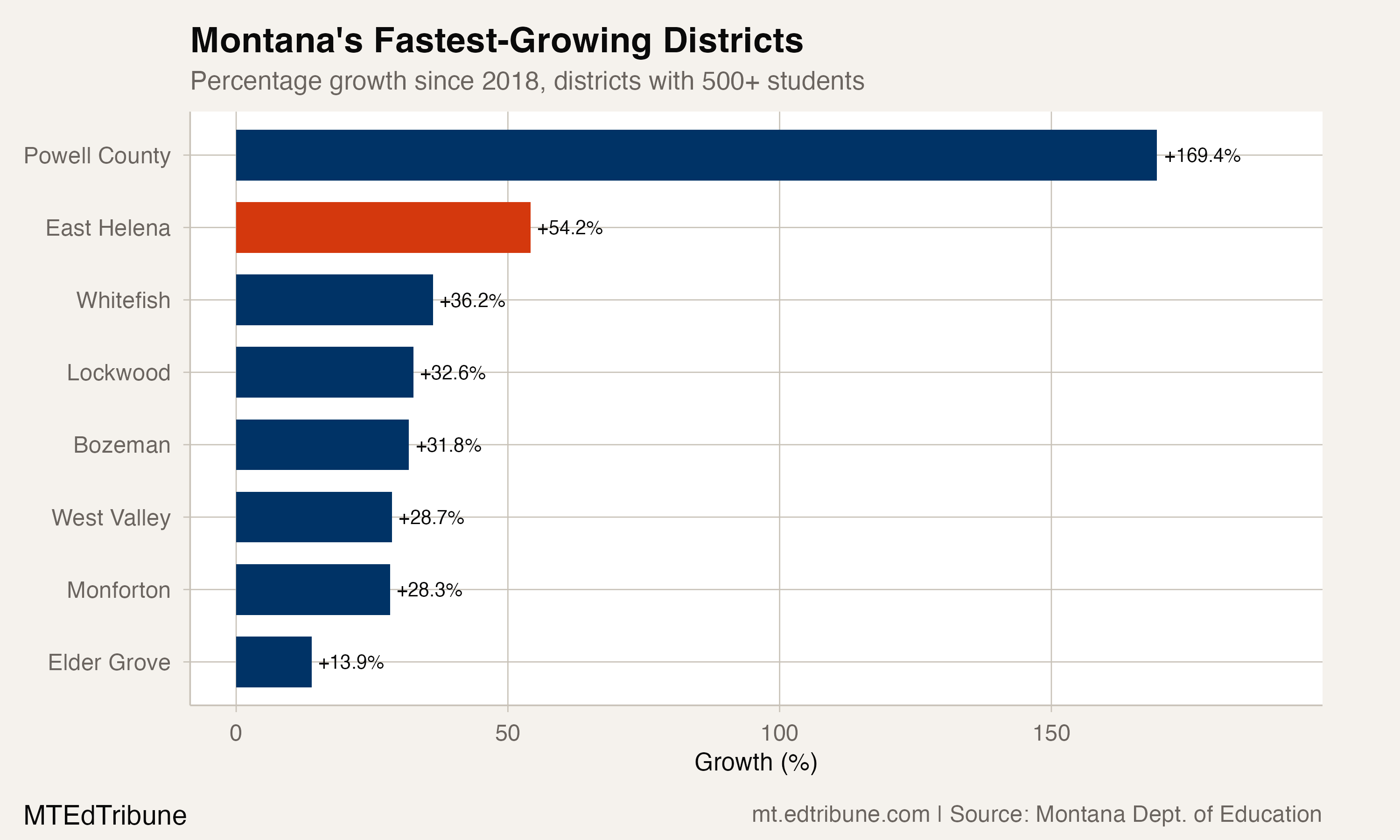
The districts immediately behind East Helena on the growth list share a common geography: the suburban rings of Montana's booming western cities. Whitefish HS grew 36.2%. Lockwood K-12, on Billings' east side, grew 32.6%. Bozeman HS grew 31.8%. West Valley Elem and Monforton Elem, both in the Gallatin Valley orbit around Bozeman, grew 28.7% and 28.3%. Elder Grove Elem, adjacent to Billings, grew 13.9%.
Every one of these districts sits on the edge of a larger city where housing costs have risen sharply. The pattern is consistent: the core city district declines or stagnates while the satellite district absorbs families seeking affordable housing within commuting distance. East Helena is the most pronounced example because it started smaller and its growth was more concentrated in time.
A demographic profile that mirrors its origin
East Helena's growth is overwhelmingly white. White students account for 83.0% of the district's 2026 enrollment, down from 86.2% in 2019. The district added 525 white students since 2019, a 48.4% increase that accounts for 77% of total growth.
Hispanic enrollment more than doubled, from 57 to 127 students, a 122.8% gain. But at 6.6% of the student body, Hispanic students remain a small share. Native American enrollment fell from 69 to 49 students, a 29.0% decline, running counter to the district's overall growth.
The demographic profile reflects East Helena's housing stock: predominantly single-family homes in new subdivisions, marketed to young families. The district is growing because of where it is and what it costs to live there, not because of demographic diversification.
The infrastructure question underneath
East Helena's enrollment trajectory hinges on decisions being made outside the school district's control. The city secured $6.9 million in sewer system revenue bonds from the state's revolving loan program to upgrade a wastewater treatment plant that is more than 25 years old. Monthly sewer fees have already risen from $66.40 to $71.50 and are projected to increase roughly $1.50 annually.
The water rights dispute is the binding constraint. If the state eventually grants East Helena access to water on the former ASARCO lands, the development pipeline of 5,000-plus homes could deliver students for decades. Helena-area Habitat for Humanity has projected that 7,000 to 9,000 new homes could be built over 20 years. The superintendent's 2022 estimate of 240 additional students from 930 proposed homes implies roughly one student per four homes, but the district's actual experience from 2019 to 2023 produced far more students per housing unit. The precise enrollment impact of the next wave of development is unknowable, but the scale of the housing pipeline dwarfs anything the current school infrastructure was built to absorb.
The school board holds 141 acres of district property, including a 50-acre parcel on the former Dartman Field that could accommodate a future school. But Montana's bonding capacity rules limit what a fast-growing district can borrow against a tax base that has not yet caught up with its student count. The wastewater plant is more than 25 years old, the water rights application is stalled, sewer fees are climbing $1.50 a year, and a pipeline of 5,000-plus homes awaits those approvals. The families are arriving faster than the infrastructure to serve them.
Detailed code that reproduces the analysis and figures in this article is available exclusively to EdTribune subscribers.
Discussion
Sign in to join the discussion.
Loading comments...