The Billings school board voted 5-1 in January 2024 to close Washington Elementary. The building was not condemned. It was not damaged. The district simply could not justify staffing a school while enrollment kept falling.
That closure arrived in the middle of what has become Montana's sharpest enrollment contraction in at least a decade. Public school enrollment peaked at 150,573 in 2023 and has dropped every year since, falling to 142,071 in 2026. The three-year loss of 8,502 students, a 5.6% decline, wiped out the entire growth era that preceded it and then some. Montana added 3,801 students between 2018 and 2023. It has now lost more than twice that.
The 2026 figure is the lowest in the nine-year dataset.
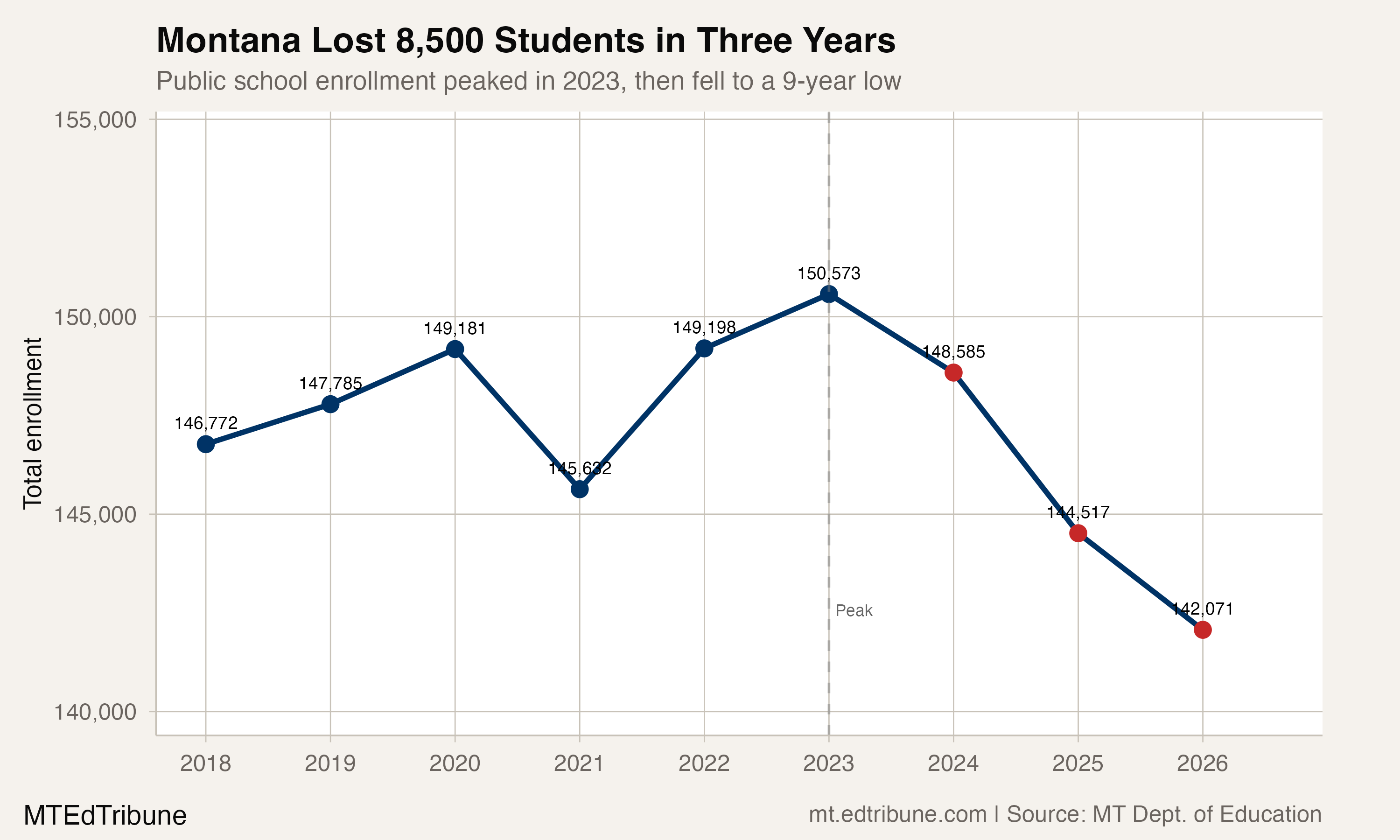
The speed of the reversal
The sharpness matters as much as the direction. Montana gained students every non-COVID year from 2018 through 2023, adding 1,013 in 2019, 1,396 in 2020, and another 1,375 in 2023 after a strong post-pandemic bounce of 3,566 in 2022. Then 2024 brought a loss of 1,988 students, a figure Superintendent of Public Instruction Elsie Arntzen called "the first enrollment decrease after 12 consecutive years of increases."
That first drop turned out to be the mildest of three. The 2025 decline of 4,068 was the largest single-year loss in the dataset outside of COVID's 3,549-student drop in 2021. Then 2026 brought another 2,446-student loss. Combined, the three post-peak years have exceeded the COVID year's damage by a factor of 2.4.
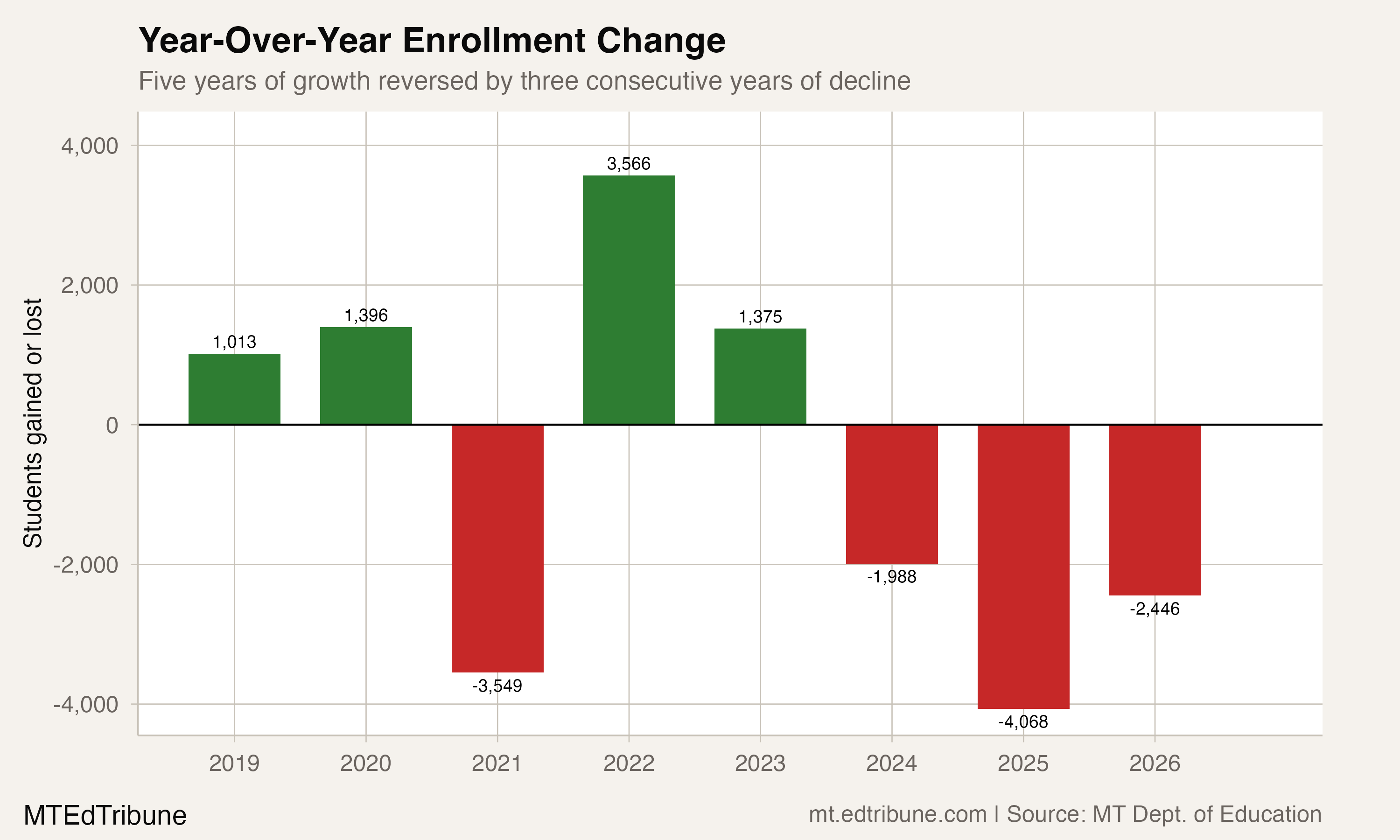
The pattern is not a gradual slide. It is a reversal: five years of accumulation followed by three years of faster erasure.
Where the students disappeared
Billings Elem↗ET, Montana's largest district at 10,737 students, has lost 1,000 since its 2020 peak, an 8.5% decline. Missoula Elem↗ET peaked that same year at 5,719 and has fallen to 4,962, a 13.2% loss. Helena Elem↗ET dropped from 5,340 to 4,836, losing 9.4%. Great Falls Elem↗ET, which peaked a year earlier, has shed 614 students, or 8.4%.
All eight of Montana's largest districts are below their peak enrollment. Every one.
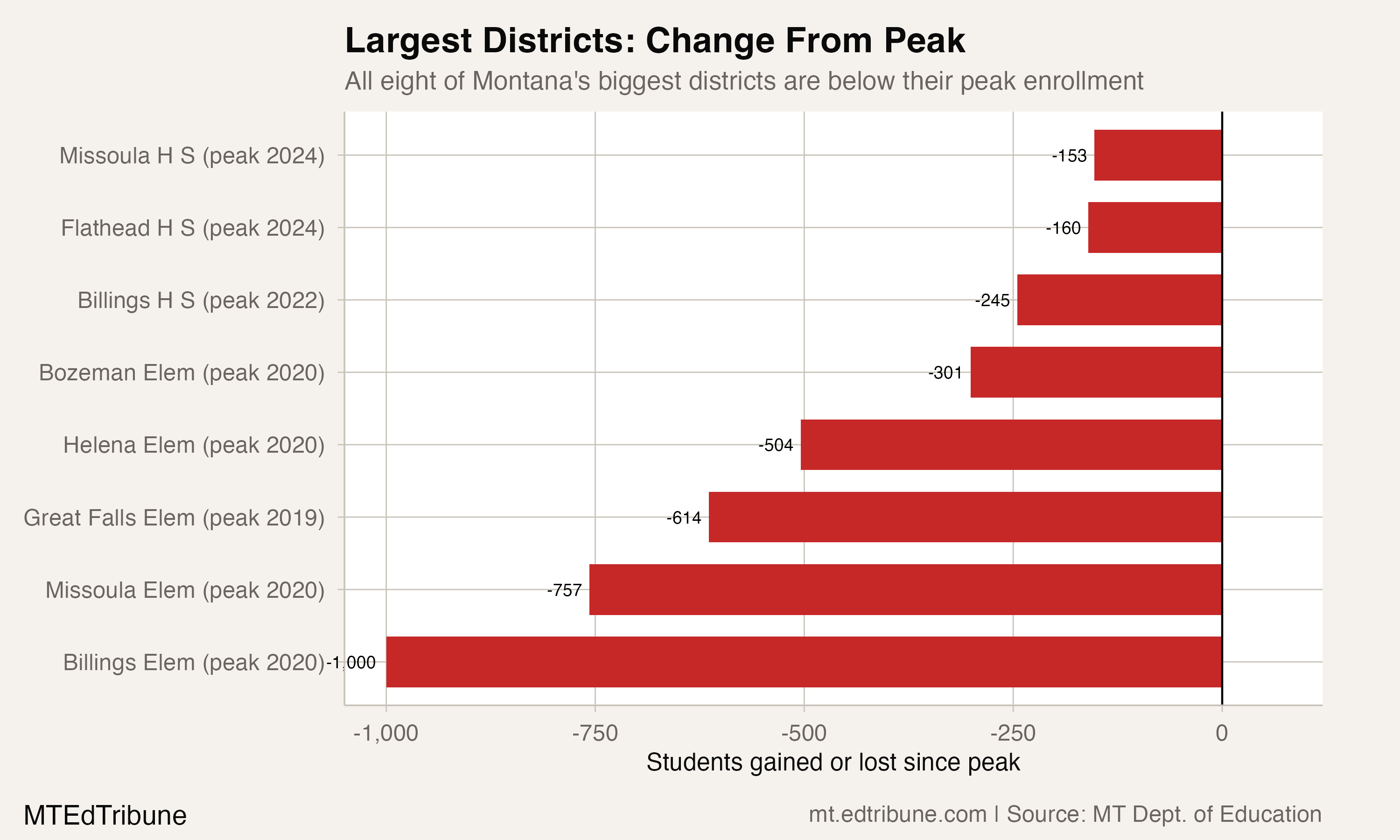
Across all 390 districts, 116 (29.7%) hit their all-time low in the current dataset in 2026. The list includes the five largest elementary districts in the state: Billings, Great Falls, Missoula, Helena, and Butte↗ET. Those five alone enroll 30,037 students, roughly 21% of the state total, and all five are at historic lows simultaneously.
In Missoula, the enrollment decline translates directly to budget pressure. Superintendent Micah Hill told the Montana Free Press that the district faced an $8 million shortfall. The elementary system alone has lost nearly 500 students since 2018, costing roughly $3.4 million in state aid.
"Hard for me not to feel emotional about it." — Micah Hill, Missoula County Public Schools Superintendent, Montana Free Press, April 2024
The funding formula's arithmetic
Montana's school funding runs through Average Number Belonging, or ANB: a per-student measurement that determines state base aid and sets each district's maximum general fund budget. When students leave, the money follows them out the door. Great Falls Public Schools budget director Brian Patrick described how "as much as 90% of the district's general fund is already dedicated to staff salaries and benefits," leaving almost no cushion when enrollment dips. Under the formula, the statewide loss of 8,502 students translates to tens of millions in reduced funding capacity across districts.
The financial pain is compounded by an inflation gap. The Legislature has approved approximately 3% annual increases to per-student funding rates. Bozeman Superintendent Casey Bertram told reporters: "When inflation is well above that, you're going in the wrong direction and it's going to be very challenging." Consumer inflation reached 8% in 2022 while state funding adjustments stayed at roughly 3%.
Meanwhile, fixed costs do not shrink with enrollment. A school that loses 30 students still needs a principal, a custodian, a heating system. Helena Public Schools considered cutting nearly 100 positions if levy elections failed.
Who is gaining what Montana is losing
Not all of those 8,502 students vanished from the state. Some moved to non-public settings. OPI reported that 8,524 Montana students were homeschooled in 2023-24, a 9.3% increase over the prior year. Combined with 8,584 private school students, a total of 17,108 students sat outside public schools, up 2.4%.
Superintendent Arntzen attributed some of the shift to families "moving out of state and parents that desire more engagement in their children's education through homeschooling."
But homeschool growth accounts for only a fraction of the public school decline. The 725-student increase in homeschooling in 2023-24 covers roughly a third of that year's 1,988-student public school loss. The larger driver is demographic. Montana's population growth rate fell to 0.52% in 2024, its lowest since 2002, and the Bureau of Business and Economic Research at the University of Montana noted that deaths have exceeded births by 3,000 since the 2020 Census. The school-age share of Montana's population has dropped from 20% to 15% over 30 years, according to the Montana School Boards Association. Montana is growing older, not younger.
Nearly all of Montana's post-2020 population growth came from domestic migration, not births. The pandemic-era influx of remote workers to Bozeman and the Flathead Valley has cooled, and those who did arrive were disproportionately adults without school-age children. That pattern produces homebuyers, not kindergartners.
The elementary pipeline is collapsing
The decline is not evenly distributed across grade levels. Elementary enrollment (grades 1 through 5) has fallen from 57,717 in 2018 to 54,474 in 2026, a loss of 3,243 students (5.6%). High school enrollment (grades 9 through 12) grew from 42,116 to 43,736 over the same period, gaining 1,620 students (3.8%).
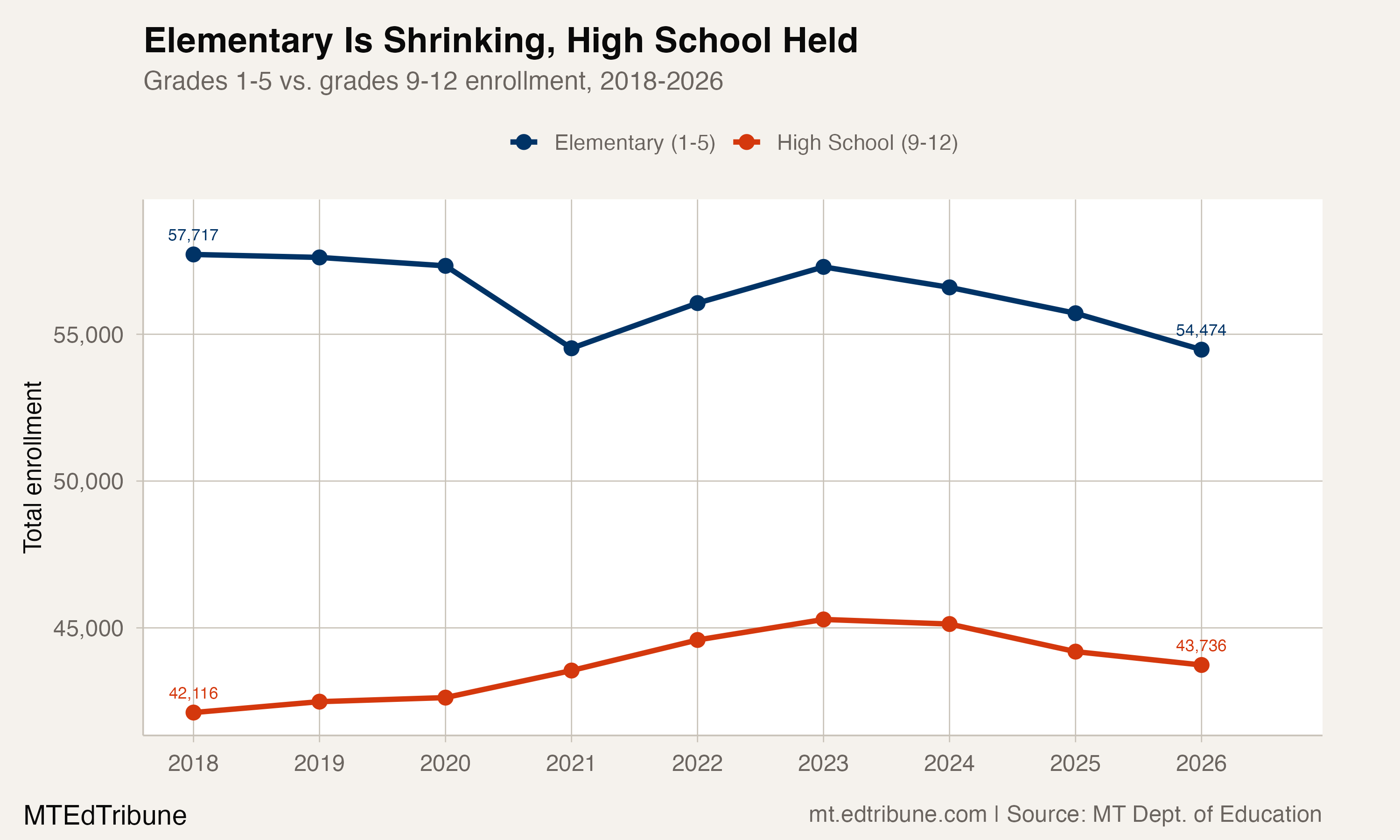
The most telling indicator is the ratio between first grade and twelfth grade. In 2018, Montana enrolled 118 first graders for every 100 twelfth graders. By 2026, that ratio flipped: 96 first graders for every 100 seniors. For the first time in the dataset, grade 12 is larger than grade 1, with 10,421 seniors and just 10,036 first graders. That inversion signals that the statewide decline has not yet fully hit high schools. When Montana's smaller 2026 elementary cohorts reach ninth grade, the high school buffer will disappear.
In Park County, where the Livingston Enterprise reported a community survey finding 83% of families want "flexible, self-directed and collaborative learning," local officials are developing a charter school, Park Pathways, targeting grades 7 through 12. Park County enrollment has dropped from 2,037 to 1,608 over 16 years, according to the Livingston Enterprise.
How far below trajectory
Had Montana continued growing at its pre-COVID pace (averaging 1,204 students per year from 2018 to 2020), the state would have enrolled 156,408 students in 2026. Instead, it enrolled 142,071. The gap is 14,337 students.
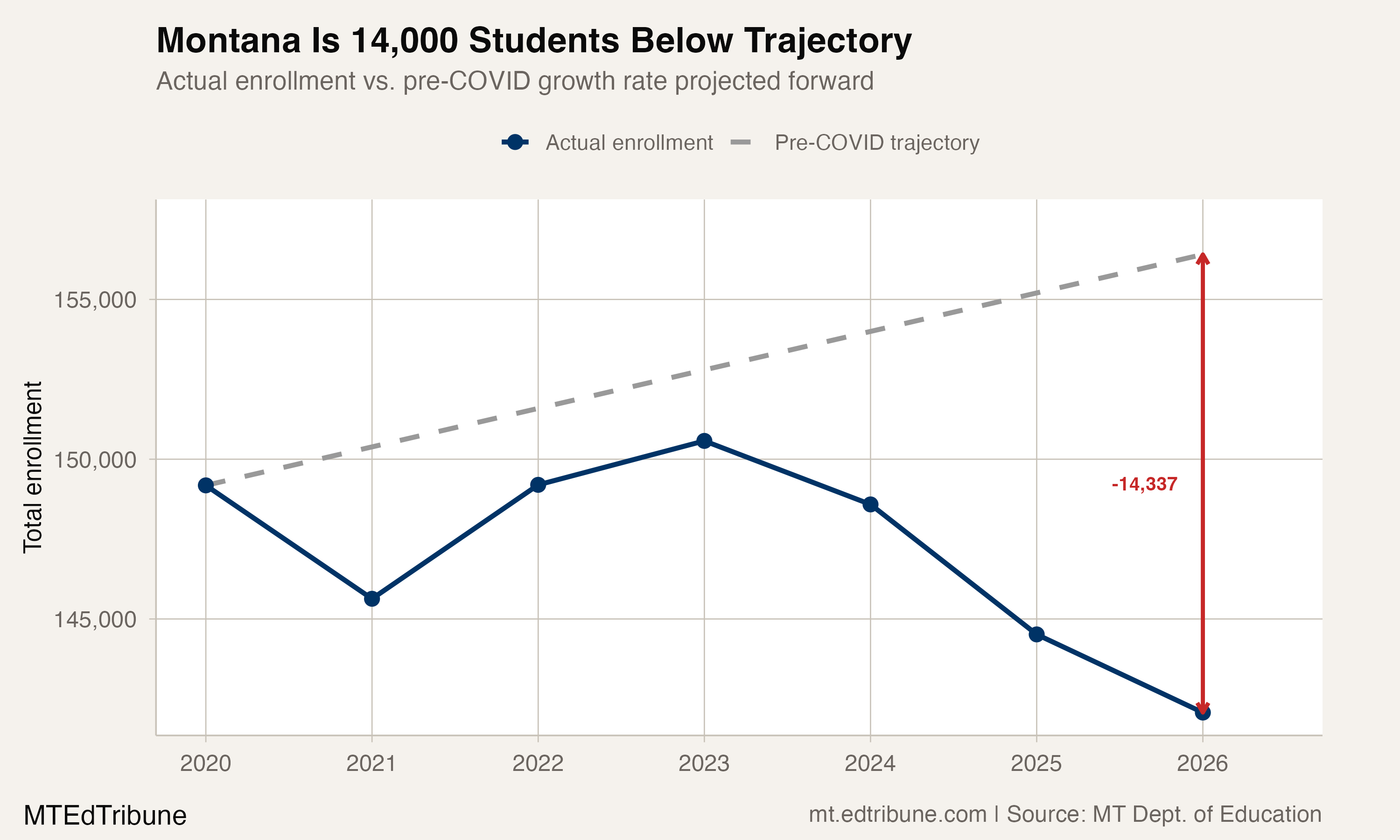
That gap represents the compound effect of pandemic disruption followed by structural decline. COVID cost Montana 3,549 students in a single year. The state bounced back aggressively, gaining 3,566 in 2022 and appearing to recover fully. But the recovery masked the beginning of a deeper slide. The bounce was temporary. The decline was not.
At the three-year average decline of 2,834 students per year, Montana would fall below 130,000 by 2031. Whether that pace holds depends on birth cohorts that are already small and a housing market that is not producing the affordable family homes that attract young households. Belgrade, a growing community south of Bozeman, is one of the few districts projecting enough elementary growth to need a new school. It is the exception, not the template.
The question for Montana's 390 districts, 330 of which enroll fewer than 500 students, is not whether enrollment will stabilize. It is whether a funding formula built for a growing state can sustain a shrinking one.
Detailed code that reproduces the analysis and figures in this article is available exclusively to EdTribune subscribers.
Discussion
Sign in to join the discussion.
Loading comments...