In West Yellowstone↗ET, the gateway town where Yellowstone National Park meets U.S. Highway 20, nearly half the students in the local school are Hispanic. That share, 47.0%, would be unremarkable in New Mexico or South Texas. In Montana, a state that is 76% white in its public schools, it is extraordinary.
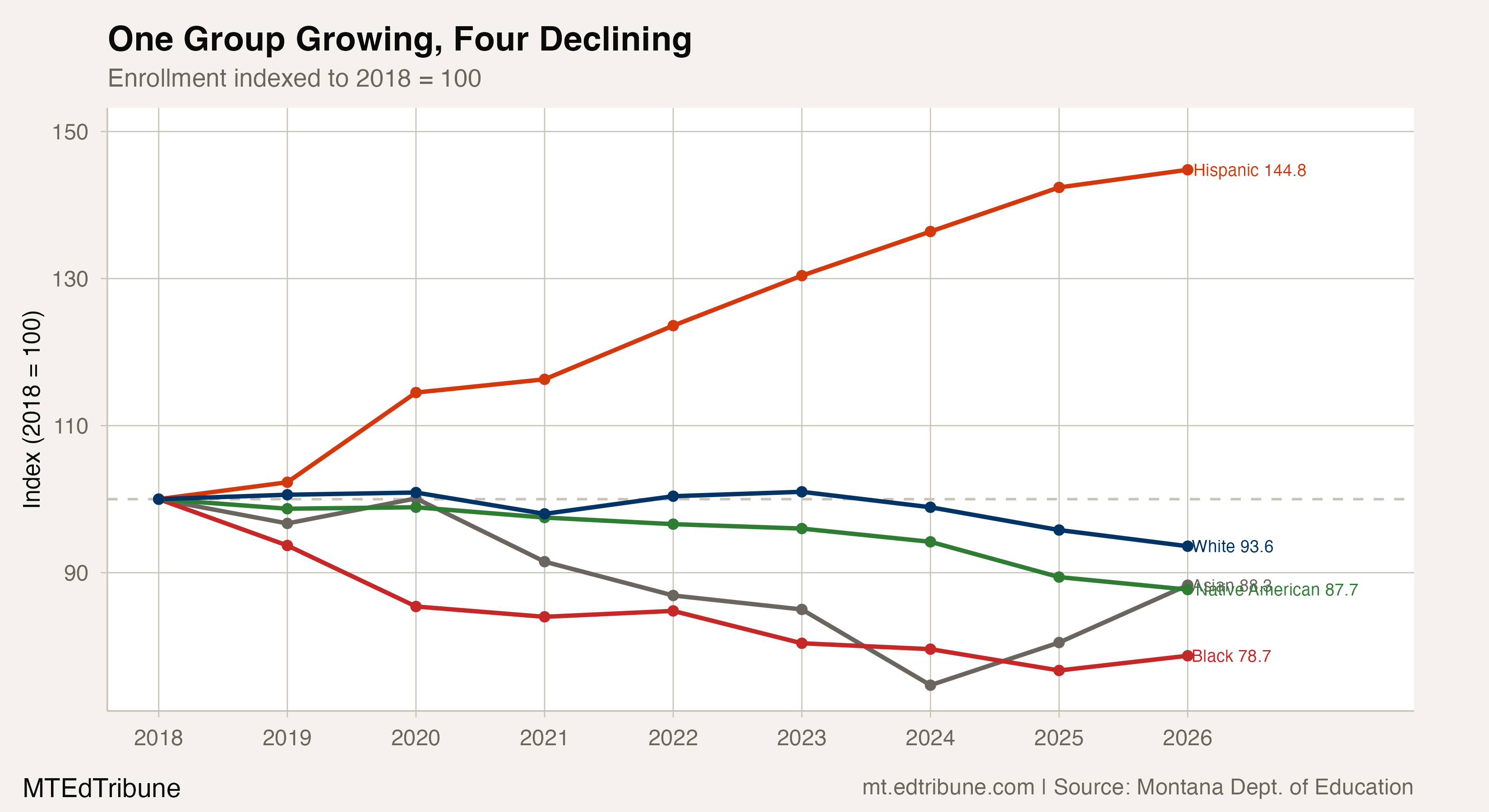
West Yellowstone is an outlier, but the direction it points is not. Hispanic students are the only racial group growing in Montana's public schools. Since the 2017-18 school year, Hispanic enrollment has climbed from 6,483 to 9,387, a gain of 2,904 students, or 44.8%. In the same period, every other group the state tracks shrank: white students fell 6.4%, Native American students 12.3%, Black students 21.3%, and Asian students 11.7%.
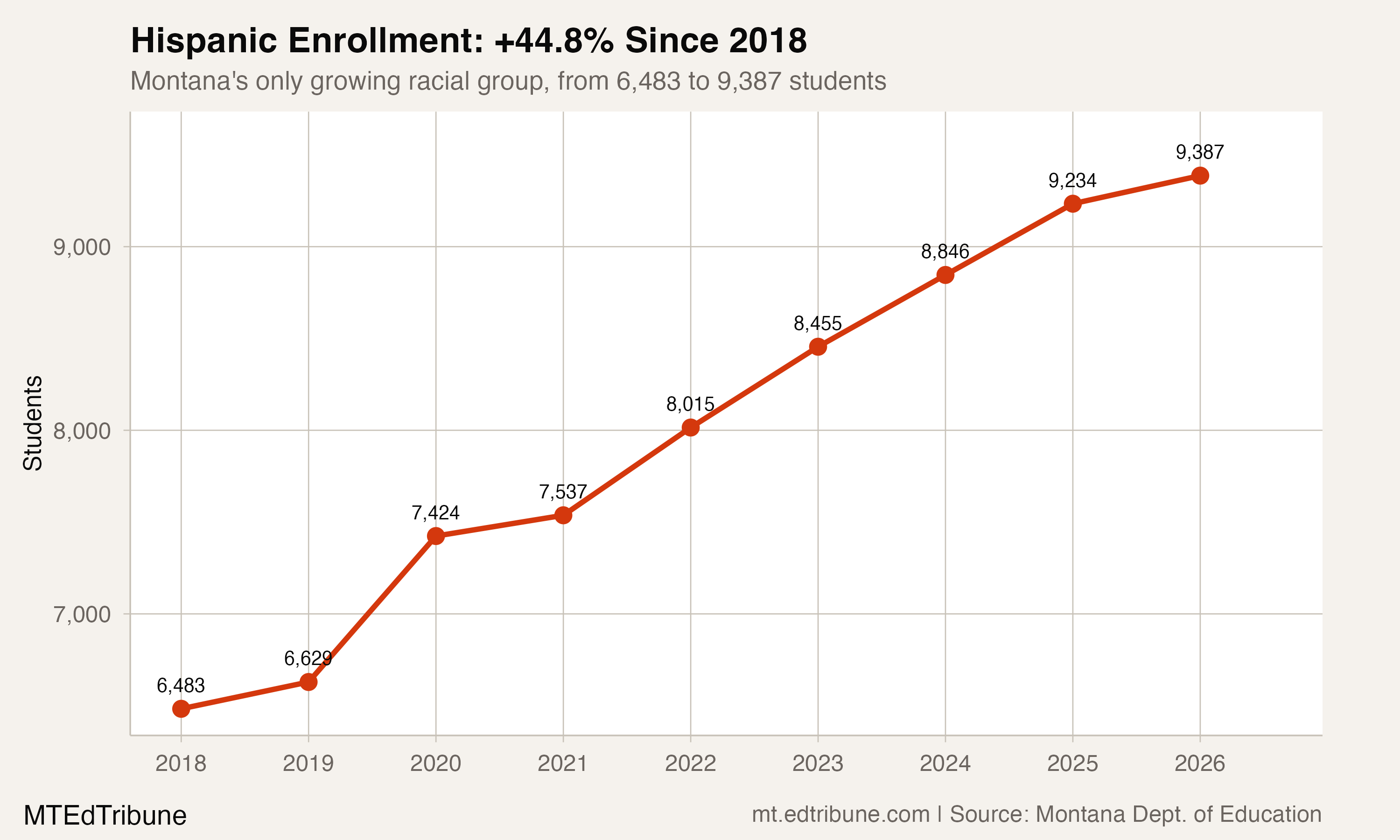
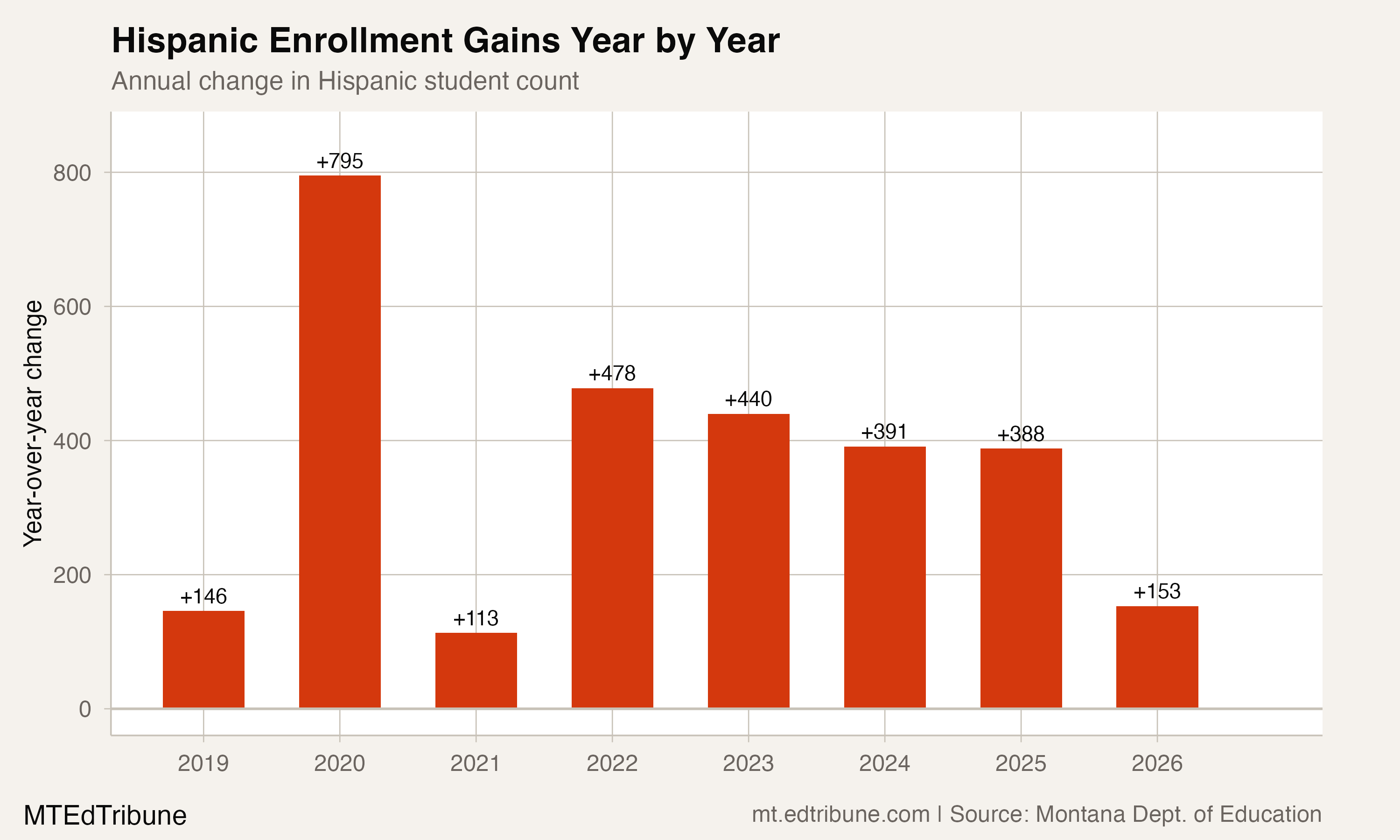
The growth has been remarkably steady. Hispanic enrollment increased every single year in the dataset, even during the 2020-21 COVID disruption that knocked total enrollment down by 3,549 students. Hispanic students added 795 in the 2019-20 school year alone, the largest single-year jump, then settled into a pace of roughly 400 per year through 2025.
A century-old connection
The presence of Hispanic families in Montana is not new. It dates to the sugar beet fields of the Yellowstone Valley, where companies like Great Western Sugar recruited thousands of Mexican and Mexican American workers starting around 1915. By 1924, the company had brought 3,604 Mexican laborers to harvest a record 31,000 acres, and some of those families stayed. Billings neighborhoods called colonias took root. Community organizations like the Comision Honorifica Mexicana formed as early as 1929 to advocate for education and social services.
What is new is the pace. Montana's Hispanic population grew 119.2% between 2000 and 2017, far outstripping overall population growth. In public schools, Hispanic students' share of enrollment has risen from 4.4% to 6.6% since 2018, a gain of 2.2 percentage points. That may sound modest, but in a state where white enrollment still accounts for more than three-quarters of students, it represents the fastest demographic shift in the data.
Growth across the map, not just the beet fields
The geographic pattern is striking. Hispanic enrollment gains are not confined to agricultural areas. Bozeman Elem↗ET added the most Hispanic students of any district, going from 223 to 636, a 185.2% increase that lifted its Hispanic share to 13.9%. Helena Elem↗ET gained 207. Great Falls Elem↗ET gained 206. Belgrade Elem↗ET, in the Gallatin Valley's fast-growing suburban corridor, gained 142, pushing its Hispanic share to 13.5%.
These are not meatpacking towns or agricultural centers. They are Montana's university cities, military-adjacent communities, and bedroom suburbs. The breadth of the growth suggests that the labor-migration patterns pulling Hispanic families into the state extend well beyond agriculture into construction, service, and hospitality sectors that have expanded alongside Montana's broader population boom.
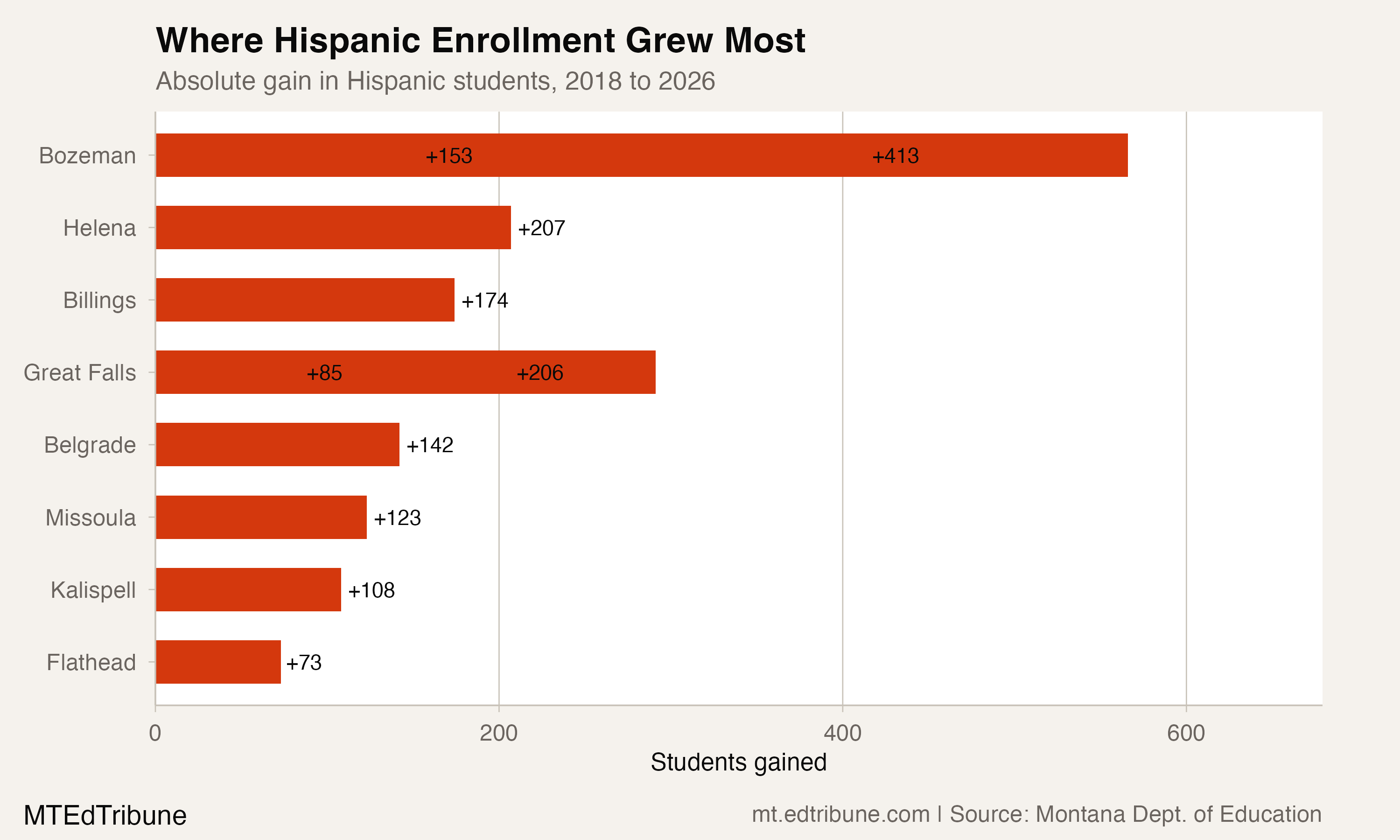
In Billings Elem↗ET, the state's largest district, Hispanic enrollment rose from 1,037 to 1,211, lifting the Hispanic share from 9.0% to 11.3%. The district opened its Multilingual Academy in fall 2024, a charter school serving students whose first languages include Mandarin, Swahili, and Tagalog. The academy launched with 40 students, drawing from a population of English learners that had grown from 25 districtwide in 2015-16 to 348 by fall 2023.
"The population of English learners has grown exponentially due to increasing global migration and political crises in places like Venezuela." -- Montana Free Press, Sept. 2025
Lutheran Family Services Rocky Mountains opened a refugee resettlement office in Billings in 2024, making it Montana's second city approved for resettlement alongside Missoula. That office signals a structural pipeline: refugee arrivals feed directly into school enrollment, and families placed in Billings tend to stay.
Where every other group is shrinking
In 22 of Montana's 58 districts with 500 or more students, Hispanic enrollment is the only racial group that grew between 2018 and 2026. The list includes every major city: Missoula Elem↗ET, Kalispell Elem↗ET, Great Falls Elem, Bozeman Elem, and Butte Elem. In each, white, Native American, Black, and Asian enrollment all fell or held flat while Hispanic numbers rose.
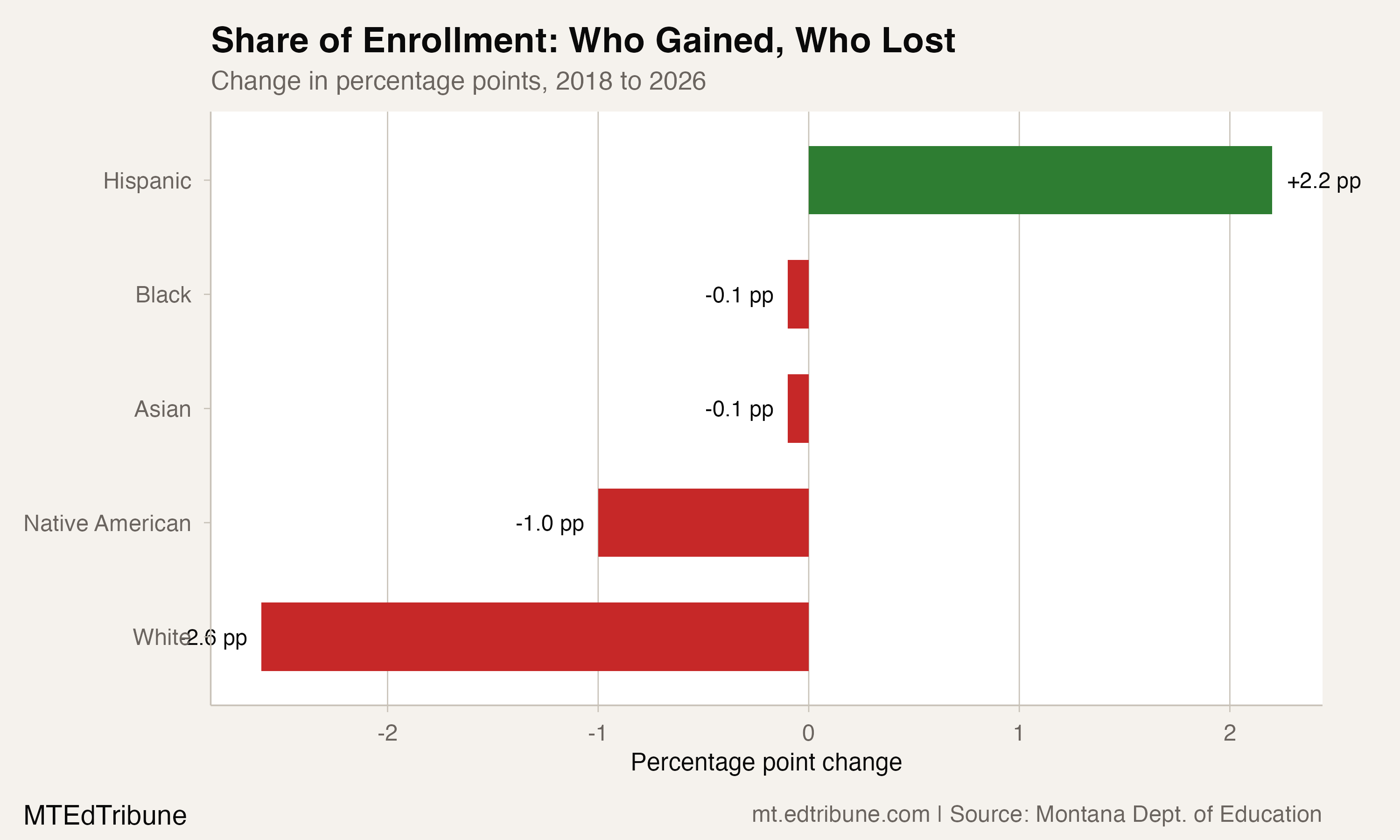
The statewide share shifts tell the story in aggregate: white students lost 2.6 percentage points of share, Native American students lost 1.0 point, and Hispanic students gained 2.2 points. Black and Asian students, at 0.6% each of state enrollment, are too small in Montana to move the share needle meaningfully, though both lost ground in absolute terms.
Montana does not report multiracial or Pacific Islander enrollment separately, which means roughly 6.4% of students fall outside the five tracked categories. It is possible that some Hispanic enrollment growth reflects reclassification from previously untracked categories rather than new arrivals. The data cannot distinguish between the two.
The 2026 slowdown
The most recent year introduces an open question. After adding roughly 390 Hispanic students annually in 2024 and 2025, the gain in 2026 dropped to just 153. That is the smallest annual increase since 2021.
One year is not a trend. But the deceleration coincides with heightened federal immigration enforcement activity in 2025-26, which has affected school enrollment in other states. Montana's immigrant communities are small enough that a shift in even a few dozen families would register in the data.
The Lockwood K-12↗ET district, which sits just outside Billings and serves a heavily working-class community, offers a window into this dynamic. Lockwood's Hispanic share climbed from 10.5% in 2018 to a peak of 13.8% in 2024, then ticked down to 13.1% in 2026. Its Hispanic student count fell from 232 to 198 over those two years. Total enrollment at Lockwood also dropped, from 1,683 to 1,514, so the decline is not unique to Hispanic families. The timing suggests that workforce-dependent communities on the urban fringe may be more exposed to both economic cycles and enforcement pressure than city centers.
What the enrollment data does not measure
The parallel growth in English learner enrollment, which rose 51.6% statewide over the same period (from 3,113 to 4,720), overlaps heavily with Hispanic growth but is not identical to it. Many Hispanic students in Montana are native English speakers from families that have been in the state for generations. And some English learners are not Hispanic. The two trends reinforce each other but measure different things.
Montana's schools remain overwhelmingly white, but in specific districts the shift is already operational. West Yellowstone's 47.0% Hispanic share, Bozeman Elem's 13.9%, Belgrade's 13.5%, and Lockwood's 13.1% mean bilingual instruction, translation services, and culturally responsive curriculum are not niche accommodations but daily necessities. In Billings, the Multilingual Academy opened its doors in fall 2024 with 40 students whose first languages include Mandarin, Swahili, and Tagalog. It is the most concrete institutional response any Montana district has built so far, one school in a state where 9,387 Hispanic students and 4,720 English learners attend classes every morning.
Detailed code that reproduces the analysis and figures in this article is available exclusively to EdTribune subscribers.
Discussion
Sign in to join the discussion.
Loading comments...