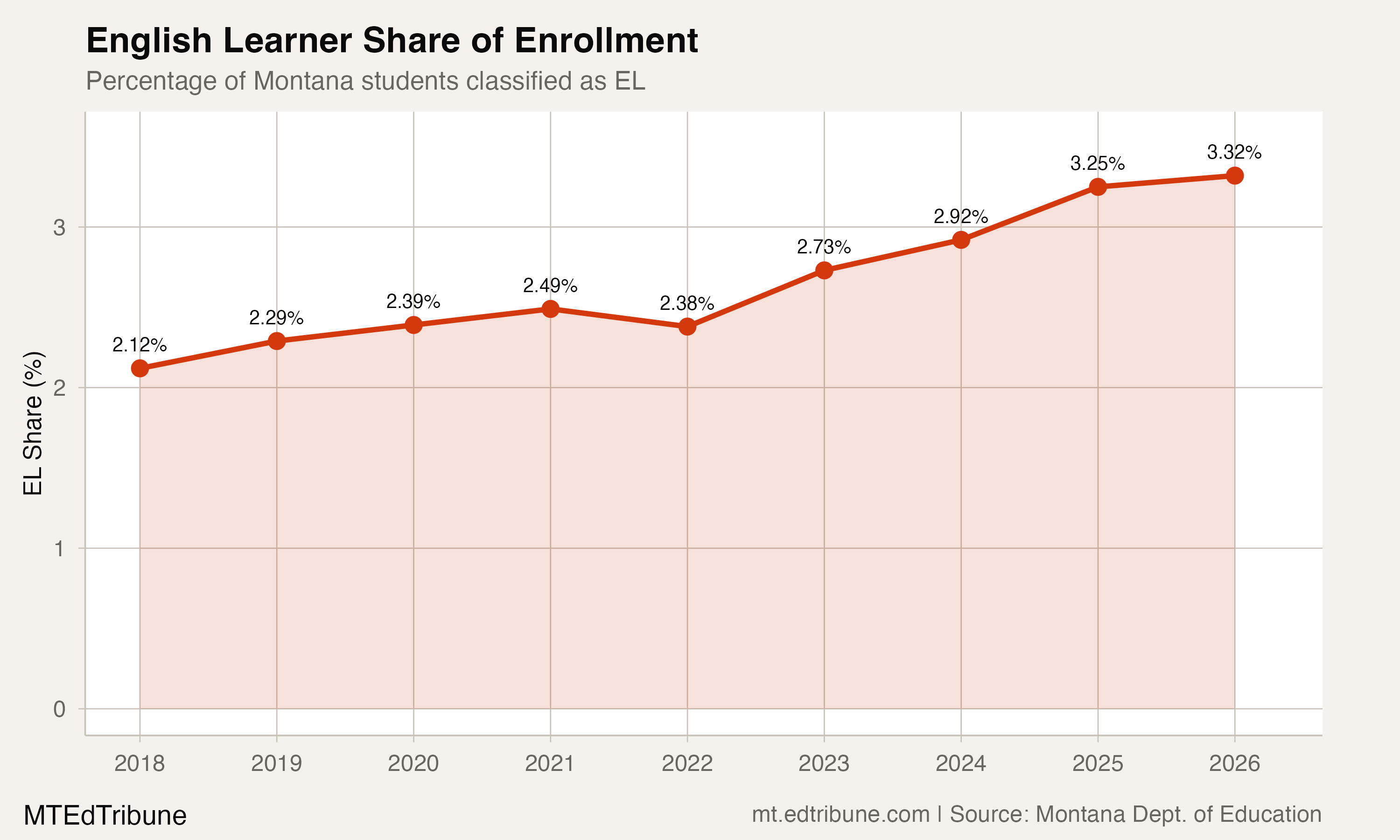
Forty-six teachers. That is the number of educators in Montana who renewed or obtained an English Second Language Learner endorsement in 2024-25, according to a February 2026 OPI presentation to the state's School Funding Interim Commission. Those 46 teachers serve a student population that has grown 51.6% in eight years and now numbers 4,720.
The number of students who are English learners in Montana rose from 3,113 in 2017-18 to 4,720 in 2025-26, a gain of 1,607. Over the same period, total enrollment fell 3.2%, from 146,772 to 142,071. The contrast is striking: indexed to 2018, the count of students learning English stands at 152 while total enrollment sits at 97. In a state shedding students overall, classrooms have grown more linguistically diverse.
The story behind that growth is not what most readers assume when they hear "English learner surge." In states like Iowa or Minnesota, rising counts are driven almost entirely by Spanish-speaking immigrant families. In Montana, OPI data show that Native American languages are the largest "language of impact" at 45.2% of students who are English learners. Spanish accounts for 25.4%. German, largely from Hutterite colony families, represents 11.8%.
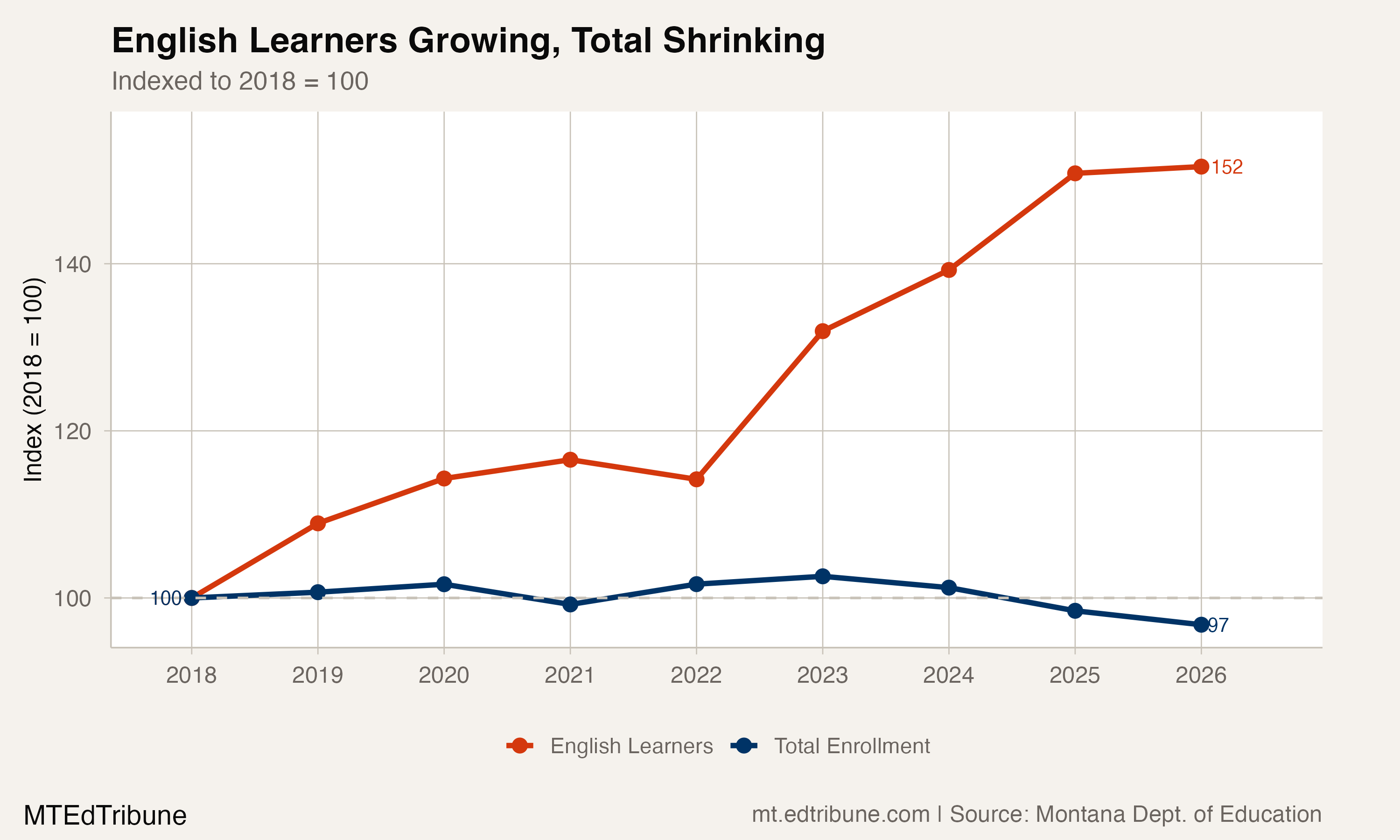
Two Surges, One Label
The English learner classification in Montana captures two distinct student populations with different needs, different geographies, and different trajectories.
The first is reservation-area students whose primary home language is Blackfeet, Crow, Cheyenne, Salish, or one of several other tribal languages. These students are not immigrants. Their families have lived in Montana for thousands of years. They are classified as English learners because a home language survey upon enrollment identifies a non-English primary language, and the WIDA Screener confirms they would benefit from English language support. OPI issues a Class 7 Native American Language and Culture Specialist license for tribal language instructors, with 23 active licenses statewide in 2025-26 spread across nine endorsement areas including Crow, Blackfeet, and Cheyenne.
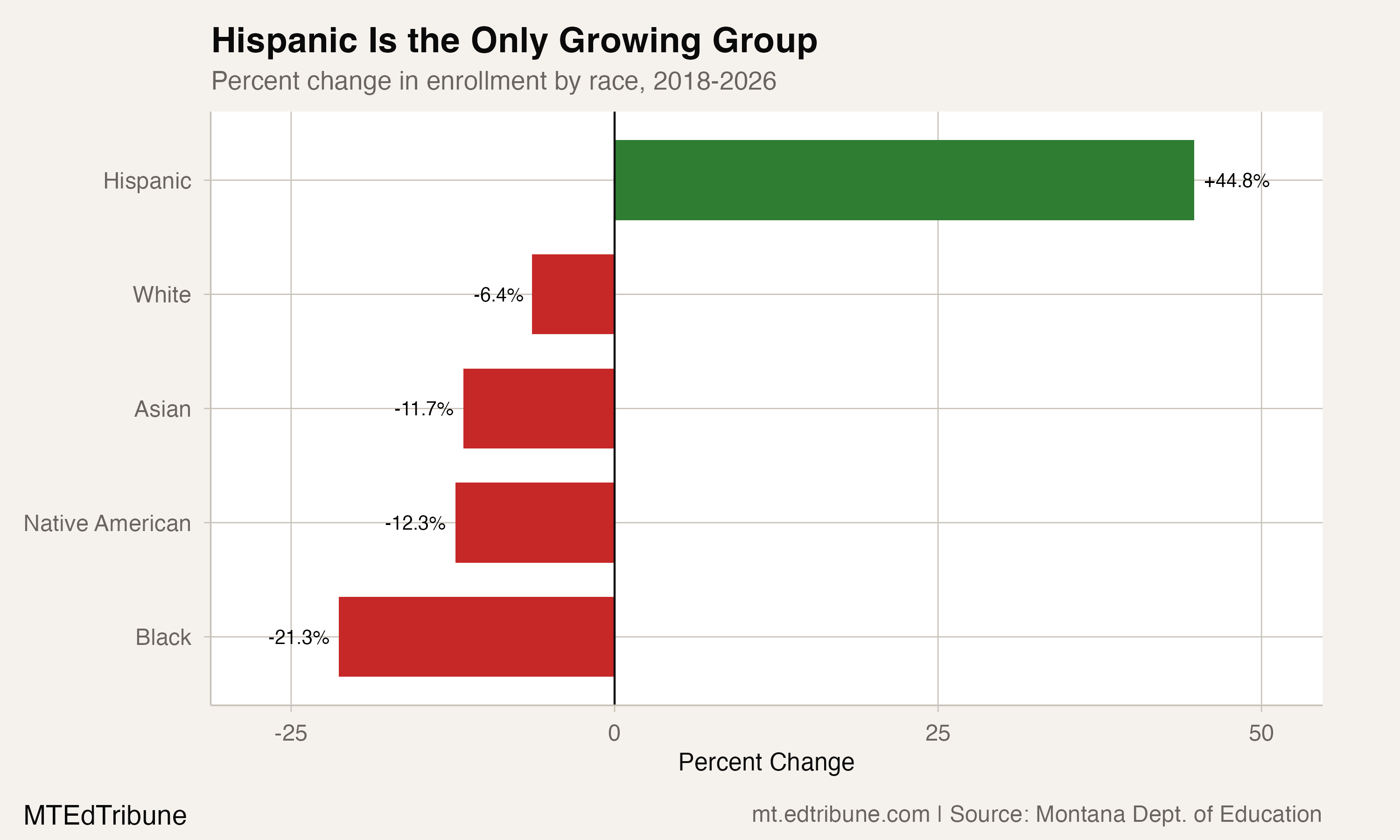
The second is the growing Spanish-speaking population, concentrated in agricultural communities and urban centers. Hispanic enrollment has grown 44.8% since 2018, from 6,483 to 9,387, making it Montana's only growing racial group. White enrollment fell 6.4%, Native American 12.3%, Black 21.3%, and Asian 11.7%.
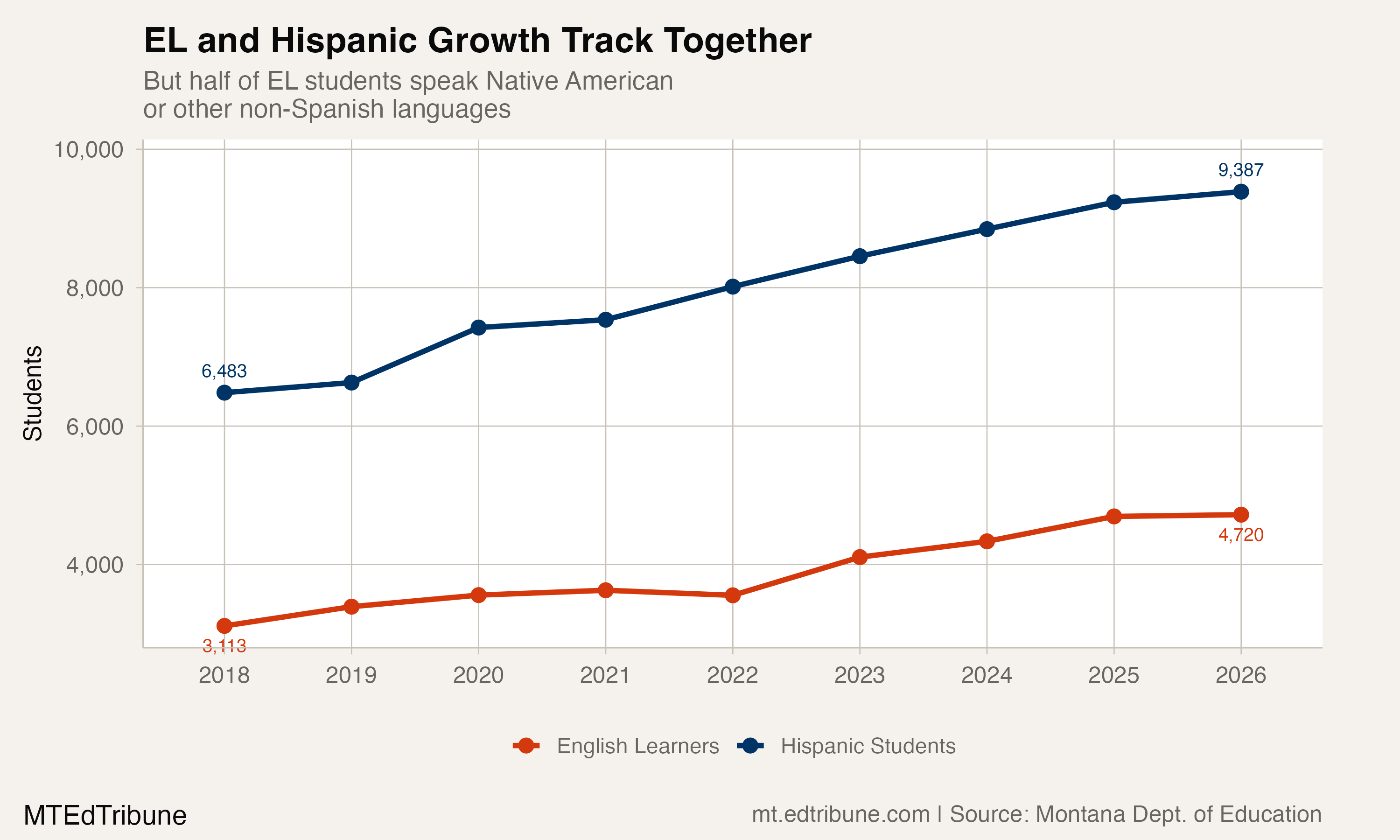
The ratio of students who are English learners to Hispanic enrollment has held remarkably steady at 48-51% across the full nine-year period, which suggests the growth is tracking new arrivals rather than reclassification of students already enrolled. If districts were simply identifying more students who were already in the system, the ratio would have climbed. It has not.
The 2023 Spike and What Followed
The year-over-year pattern reveals a distinct inflection point. From 2019 through 2022, annual growth ranged from 70 to 278 students, with a net loss of 73 in 2022. Then 2023 added 552 students in a single year, the largest annual gain in the dataset.
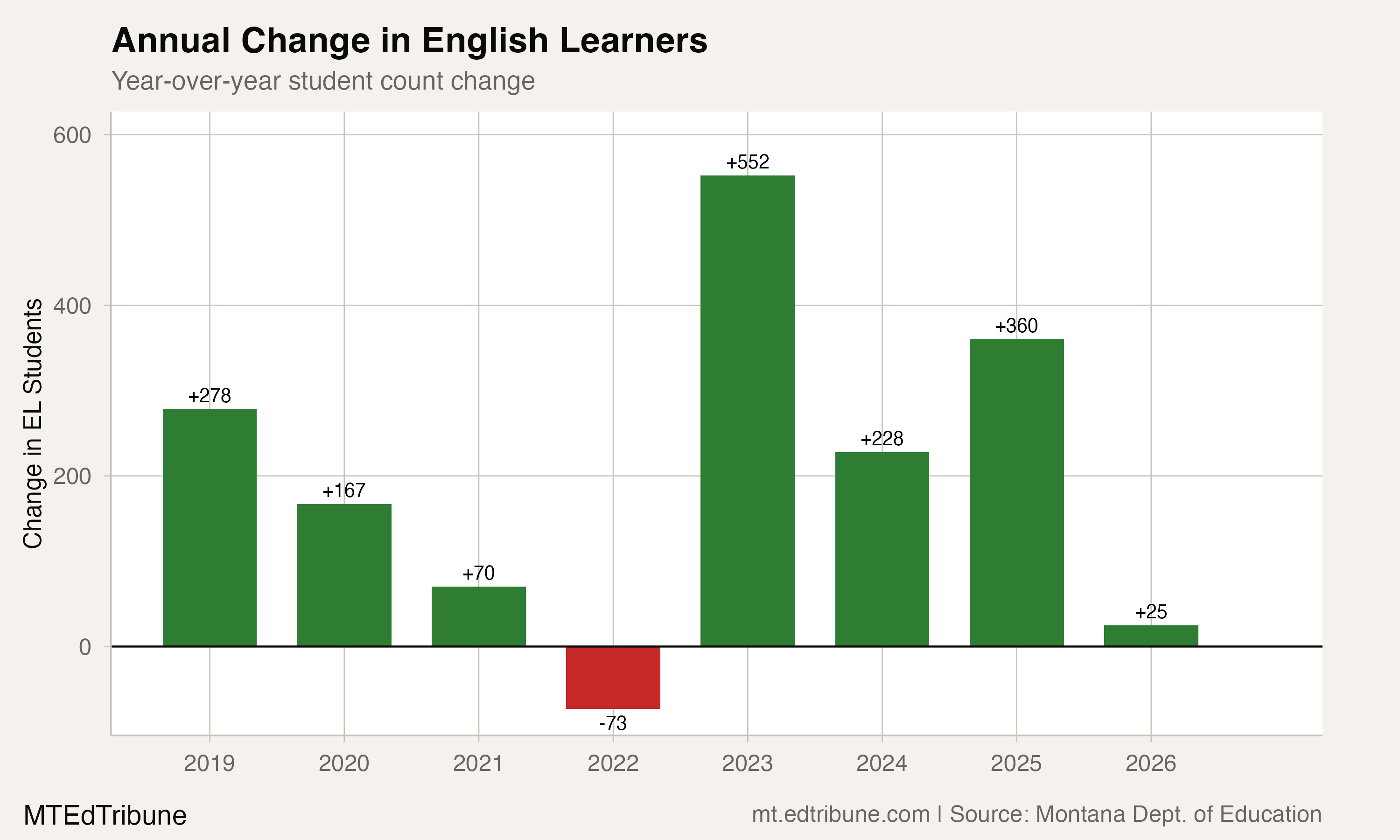
The 2023 jump coincided with increased refugee resettlement nationally and a broader post-pandemic wave of immigration. The IRC office in Missoula, which has assisted over 1,200 individuals and families since reopening in 2016, was on track for its busiest year in 2023, though the operation remains small, with an annual ceiling of 180-250 arrivals. Refugee arrivals alone cannot explain an increase of 552 students who are English learners.
The more likely drivers are a combination of continued Hispanic immigration to agricultural regions, expanded identification practices as districts become more familiar with the home language survey process, and Hutterite colony population growth. Montana's Hutterite colonies maintain German as the primary language, accounting for the 11.8% German-speaking share. OPI's data show dedicated colony schools like Spring Creek Colony Elem, King Colony Elem, and Gildford Colony Elem in the enrollment system.
Growth slowed sharply in 2026, adding only 25 students after gains of 228, 360, and 552 in the three previous years. The cause is not yet clear, though the timing tracks with intensified federal immigration enforcement nationwide.
$82 per Student
Montana is one of only two states, along with Mississippi, that does not allocate additional state funding for English learners. The entire state-level EL budget comes from federal Title III formula grants.
For fiscal year 2026, OPI's Title III allocation totaled $500,000. After $150,000 for state administration, $350,000 flowed to 61 school districts serving 4,011 students who are English learners. That works out to $82.27 per student.
For context, the national Title III average is $169 per student who is an English learner, down from an inflation-adjusted $264 per student in 2007-08. Montana's per-student allocation is less than half the national average because the state adds nothing on top of what the federal formula provides.
The 2025 Montana legislature considered HB 361, which would have appropriated $1 million for ELL program funding and $75,000 for teacher stipends, creating a state match of up to $2 for every federal dollar. The bill did not advance out of committee.
"Mississippi and Montana do not allocate additional state aid for ELs." -- Brookings Institution, 2025
The federal funding these districts depend on faces its own threat. The current administration's proposed budget for fiscal year 2027 would eliminate Title III entirely, zeroing out the only dedicated English learner funding stream in a state with no state-level alternative.
Five Percent Proficiency
The outcomes data show room for growth. Of 3,553 students who took the WIDA ACCESS test in 2024-25, 180 reached the proficiency benchmark, a rate of 5%. Thirty-six percent of progress-eligible students showed improvement on the English language assessment.
These results carry an important caveat. A 5% proficiency rate does not mean 95% of students who are English learners are failing. Many students who are English learners in Montana are newly classified, particularly in the years of rapid growth, and the WIDA assessment measures progress toward fluency over multiple years. Students in their first year of classification are not expected to test proficient. The question is whether they make progress year over year, and at 36%, fewer than four in ten are doing so by the assessment's measure.
The staffing picture frames the challenge. Montana schools listed 853 active job postings for licensed positions in August 2024, and the state issued 176 emergency employment authorizations the previous year. Montana teacher starting salaries rank last nationally at $34,476, making it difficult to recruit specialized instructors for any subject, let alone a specialty like English language development.
The Immigration Intersection
The students Montana classifies as English learners come from three communities with little else in common: Indigenous language speakers on reservations, families that have migrated from Latin America for agricultural work, and Hutterite colonies that have maintained German for centuries.
The political environment around the latter two has shifted considerably. In January 2026, the Helena City Commission adopted a resolution restricting local cooperation with federal immigration enforcement, prompting Governor Greg Gianforte and Attorney General Austin Knudsen to launch an investigation under Montana's 2021 sanctuary city ban. Valerie Hellermann, executive director of the Helena Area Refugee Resettlement Team, told the Daily Montanan that the immigrants she works with "are doing heavy lifting work that most of us don't want to do."
For school districts, the political debate is secondary to a structural reality. Districts are federally required to identify and serve students who are English learners under Title VI of the Civil Rights Act and Section 3113 of the Every Student Succeeds Act, regardless of immigration status. A student who speaks Crow at home and a student who speaks Spanish at home both need the same thing from the school system: qualified instruction in English language development. The state provides $82 per student to make it happen.
The 2026 slowdown, from 360 new students in 2025 to 25 in 2026, bears watching. If it reflects the broader national decline in immigration under intensified federal enforcement, Montana's growth could plateau even as the students already in the system continue to need services for years. Exiting English learner status takes an average of four to seven years nationally. The 1,607 additional students identified since 2018 will be in Montana classrooms for years to come, and the gap between what they need and what the state funds will follow them.
Detailed code that reproduces the analysis and figures in this article is available exclusively to EdTribune subscribers.
Discussion
Sign in to join the discussion.
Loading comments...