Park County's economy runs on Yellowstone. Four and a half million visitors a year pass through on their way to the north entrance, filling hotels and restaurants in a town of 8,000 that sits where the Yellowstone River bends through the Absaroka Range. Median home values in the county have nearly doubled since 2020. New breweries and art galleries line Main Street.
Livingston Elem↗ET, the district that serves this town, enrolled 1,000 students in 2017-18. In 2025-26, it enrolled 716. That is a loss of 284 students, or 28.4%, a rate of decline nearly nine times the statewide average. Among Montana districts with at least 200 students, only two have shrunk faster.
The paradox is not subtle. Livingston is losing children precisely because the same forces that made it prosperous have made it unaffordable for families with children.
The trajectory
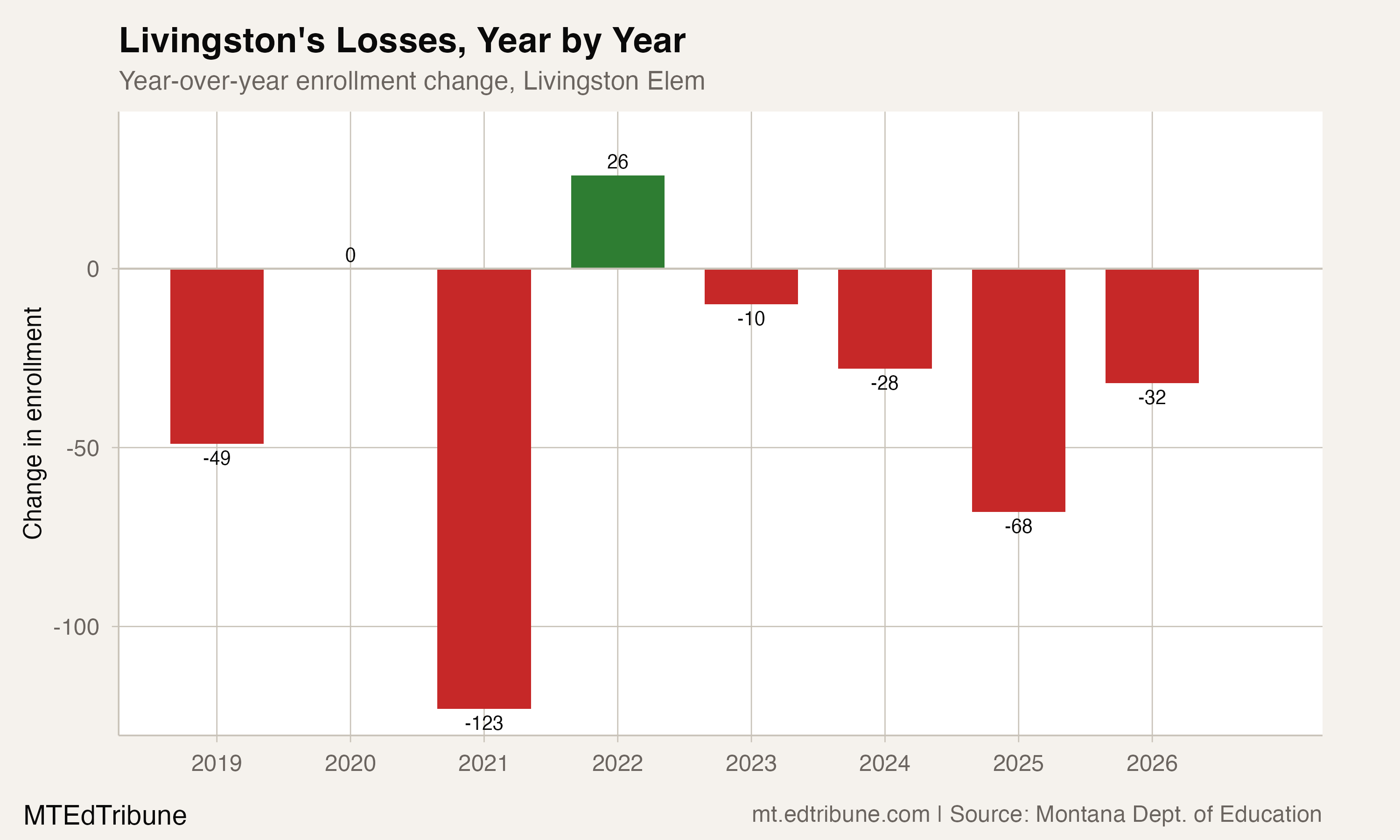
The decline has been almost unbroken. In six of the past eight year-over-year transitions, Livingston Elem lost students. The single worst year was 2020-21, when 123 students disappeared in one cycle, a 12.9% drop that coincided with both pandemic disruption and the first surge of remote-worker in-migration that reshaped Park County's housing market.
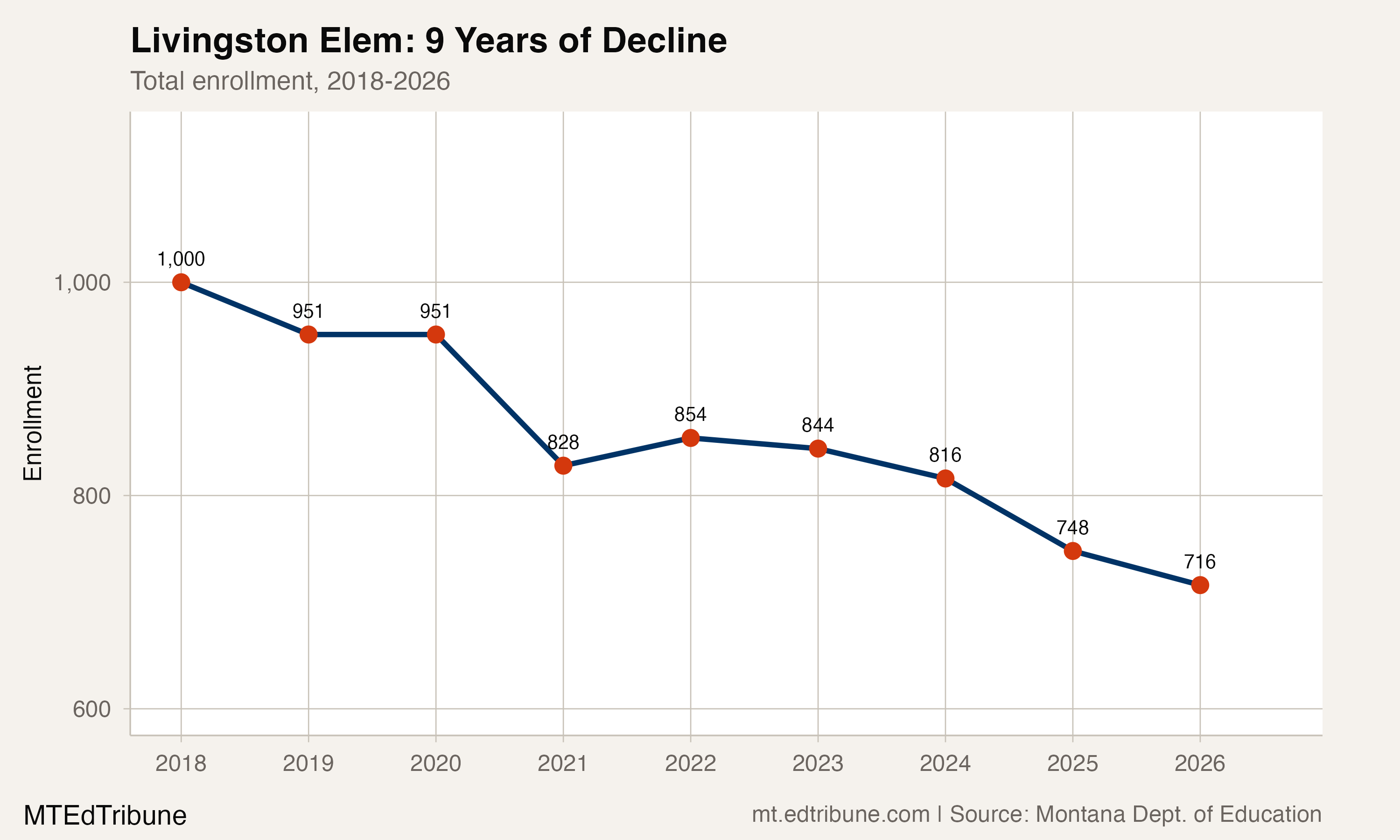
A brief rebound of 26 students in 2021-22 did not hold. The district has lost 138 students in the four years since, including 68 in 2024-25 and 32 in 2025-26.
Park H S↗ET, the high school district serving the same community, tells a different story. It enrolled 447 students in 2017-18 and 419 in 2025-26, a decline of just 6.3%. The high school's relative stability makes the elementary collapse more striking: the pipeline feeding it is thinning fast.
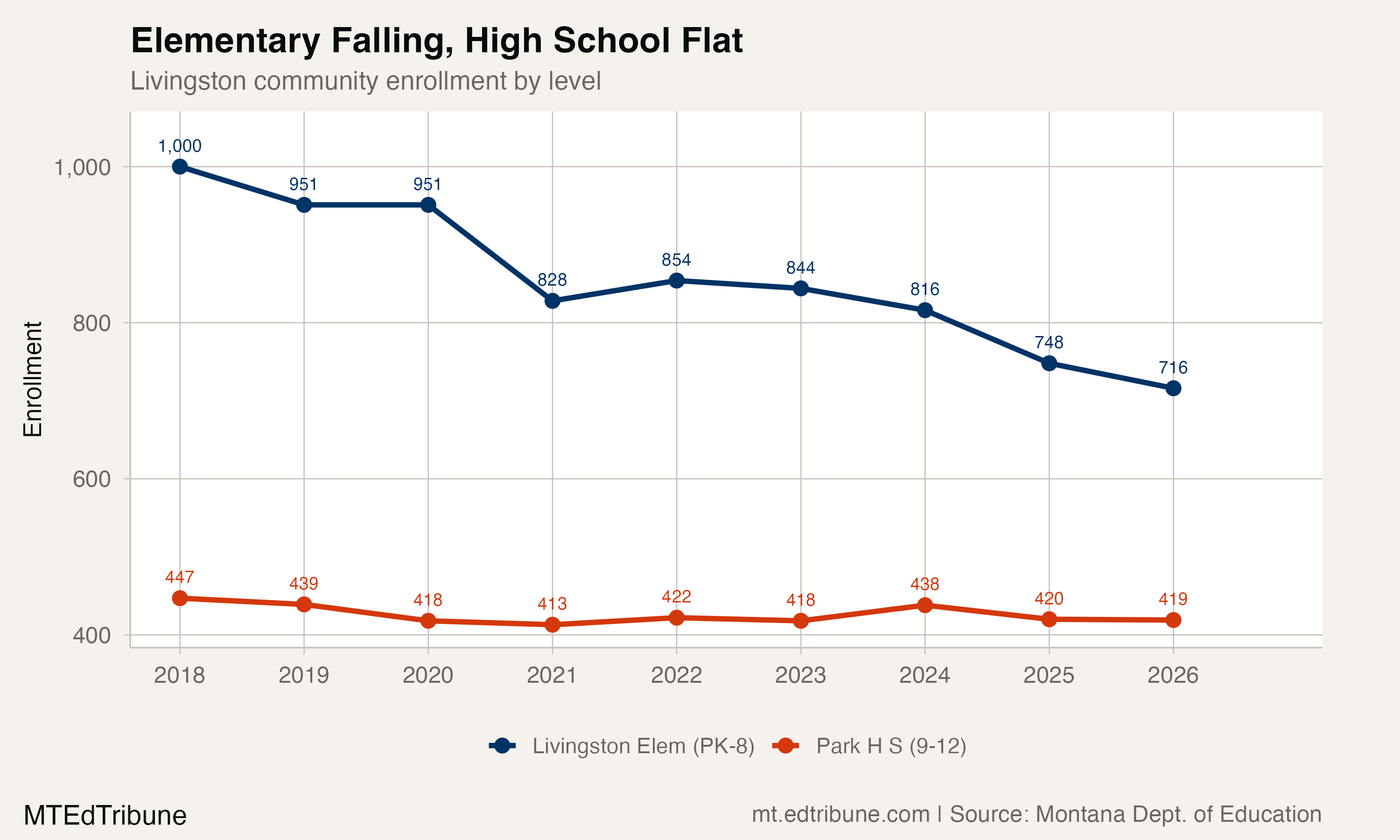
Combined, Livingston's two districts have gone from 1,447 to 1,135 students, a loss of 312, or 21.6%.
A housing market that replaced families with retirees
Montana's housing market helps explain why. Statewide, the median residential property value rose 66% in four years, from $228,000 in 2020 to $378,000 in 2024. Monthly payments on a median home more than doubled, from roughly $921 to $2,173, while per-capita income grew 26%.
Livingston sits 25 miles east of Bozeman on Interstate 90. For years it served as an affordable alternative to Gallatin County's overheated market. But remote workers, retirees, and second-home buyers who arrived during the pandemic pushed Park County's median home price past $525,000 by late 2024. Park County's median age is 46, well above the national figure of 38.9, consistent with a community where older in-migrants are displacing younger families rather than joining them.
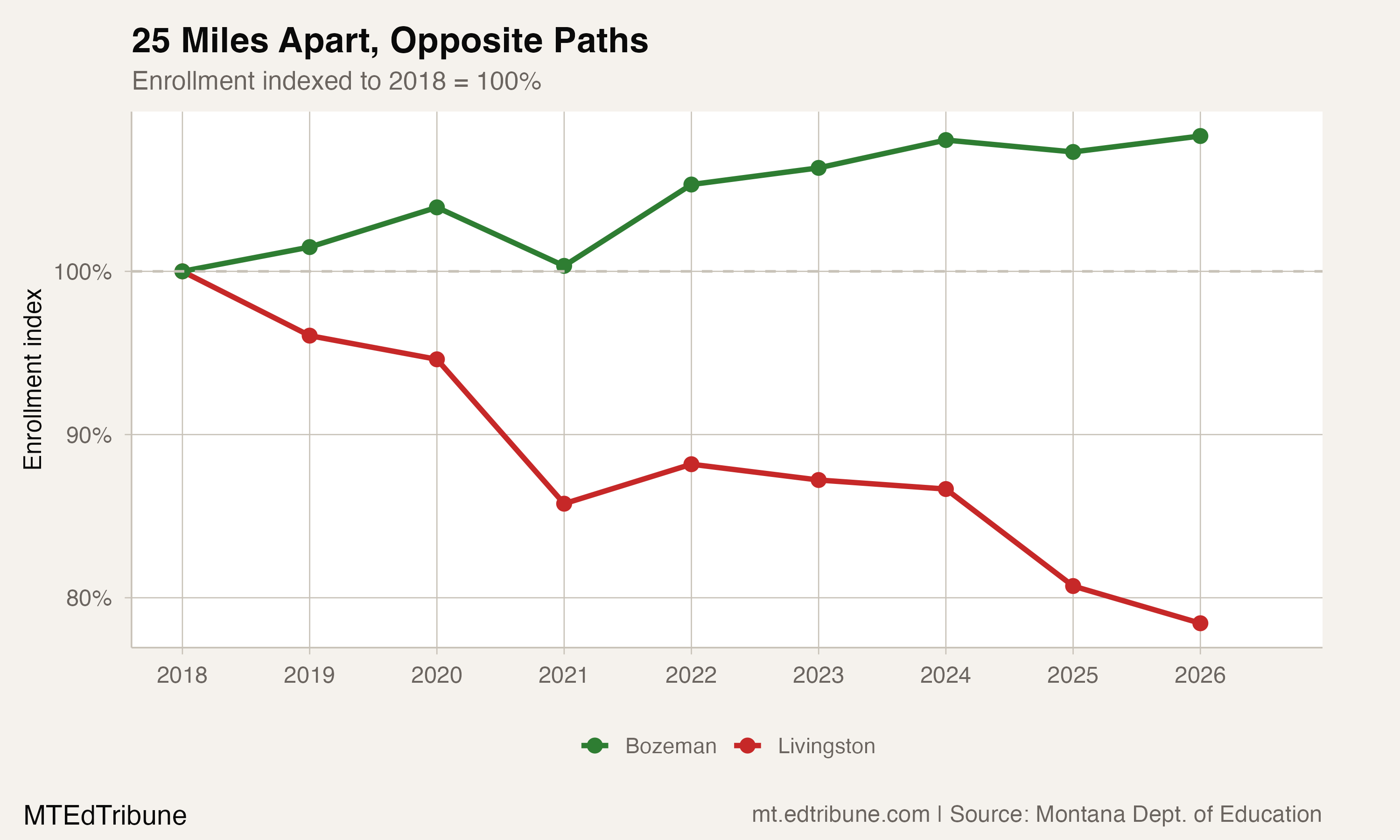
The result: Bozeman's combined enrollment (elementary and high school) grew 8.3% since 2017-18. Livingston's shrank 21.6% over the same period. Two communities connected by a 25-mile highway, moving in opposite directions.
More than housing
Housing costs are not the only force. The Livingston Enterprise reported in 2025 that district leaders see families choosing alternatives to traditional public schools at rising rates.
"We're just seeing more and more students disengage from traditional school structures. We've seen this in our early warning system where students are at risk for credit deficiency or non-graduation. We've also seen increasing attendance concerns especially since 2020 with a lot more unexcused absences." — Hannah Scheiderer, Livingston Public Schools psychologist, Livingston Enterprise
The district's own survey data found 83% of families prefer flexible, self-directed learning and 92% believe students need project-based and work-based learning opportunities. Homeschool enrollment in Park County, while modest (146 students in 2024-25), represents an additional draw on the public school headcount. Livingston's Park Pathways charter has been approved, but the district says its opening has been postponed to 2027-28; the broader cultural shift toward alternative schooling models compounds the demographic pressure.
Where Livingston ranks
Among the 133 Montana districts that enrolled at least 200 students in 2017-18, Livingston Elem's 28.4% decline ranks third. Only White Sulphur Springs K-12 (-34.7%) and Heart Butte K-12 (-33.0%) fell faster, and both are substantially smaller. Livingston is by far the largest district in the fastest-declining tier.
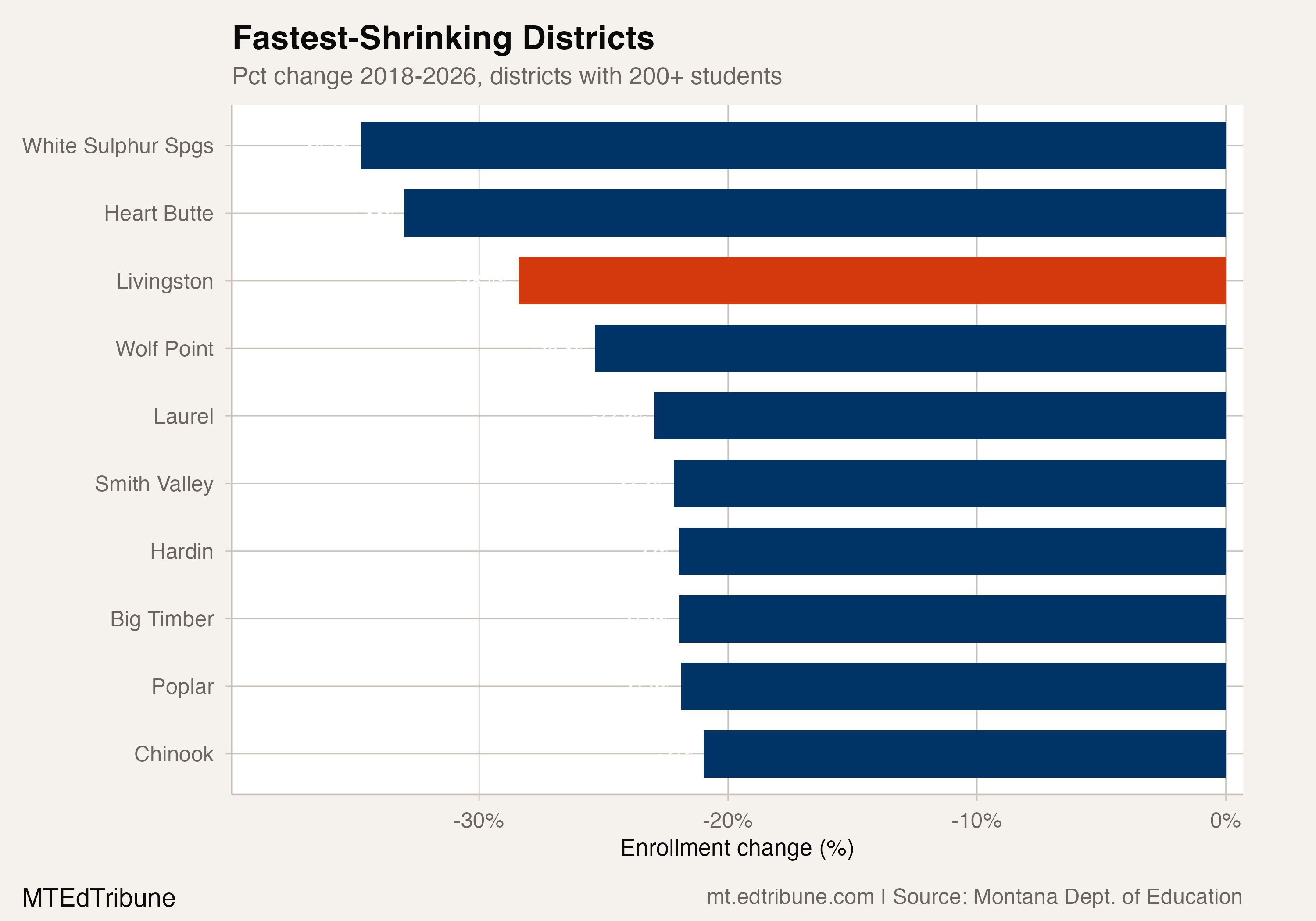
For context, Montana as a whole declined 3.2% over this period. Livingston's rate is 8.9 times the state average. Even Bozeman Elem, just down the highway and facing many of the same regional dynamics, declined only 2.5%.
The funding arithmetic
Montana funds schools primarily through Average Number Belonging (ANB), a per-student formula that delivers roughly $4,900 per elementary student and $6,300 per high school student. The state offers a three-year averaging option that softens the blow of sudden enrollment drops, but it cannot indefinitely cushion a district losing students at Livingston's pace.
At 284 fewer elementary students and the base ANB rate, the estimated state aid reduction approaches $1.4 million. Staff salaries consume as much as 90% of general fund budgets in Montana districts, leaving little room to absorb losses without cutting positions. The same Montana Free Press investigation found districts statewide struggling with a structural mismatch: the legislature approved roughly 3% annual inflationary increases to per-student rates while actual inflation exceeded 8% in 2022.
Gateway towns and missing children
Livingston is not the only Yellowstone-adjacent community losing students. Gardiner Elem, the district at the park's north entrance, has fallen from 106 to 93 students since 2017-18. Big Timber Elem, the next town east on I-90, dropped 21.9%. The pattern is consistent across Park County and its neighbors: tourism-driven economies that attract visitors, retirees, and remote professionals while pricing out the working families whose children fill school buildings.
The Livingston case is the starkest version of a dynamic visible across the Mountain West: communities that are simultaneously growing and emptying, depending on whether you measure prosperity by tax revenue or by the number of kindergarteners who show up in September. The town's economy has never been stronger. Its elementary school has never been smaller.
Livingston Elem has averaged a loss of 35 students per year over the past nine years. At that rate, it falls below 600 by the 2029-30 school year, a threshold that puts school configuration and staffing decisions on the table for a community that has never had more tourists and fewer kindergarteners at the same time.
Detailed code that reproduces the analysis and figures in this article is available exclusively to EdTribune subscribers.
Discussion
Sign in to join the discussion.
Loading comments...