For 13 consecutive years, girls in Montana have graduated at a higher rate than boys. The gap has ranged from 2.8 percentage points to 4.7 points. It has never reversed. It has never meaningfully narrowed. It has never meaningfully widened.
In 2023, the most recent year with gender data available, 87.4% of female students graduated within four years compared to 83.9% of males. The 3.5-point gap was almost exactly at the 13-year average of 3.6 points.
The persistence, rather than the size of any single year's difference, is the central pattern.
A gap frozen in place
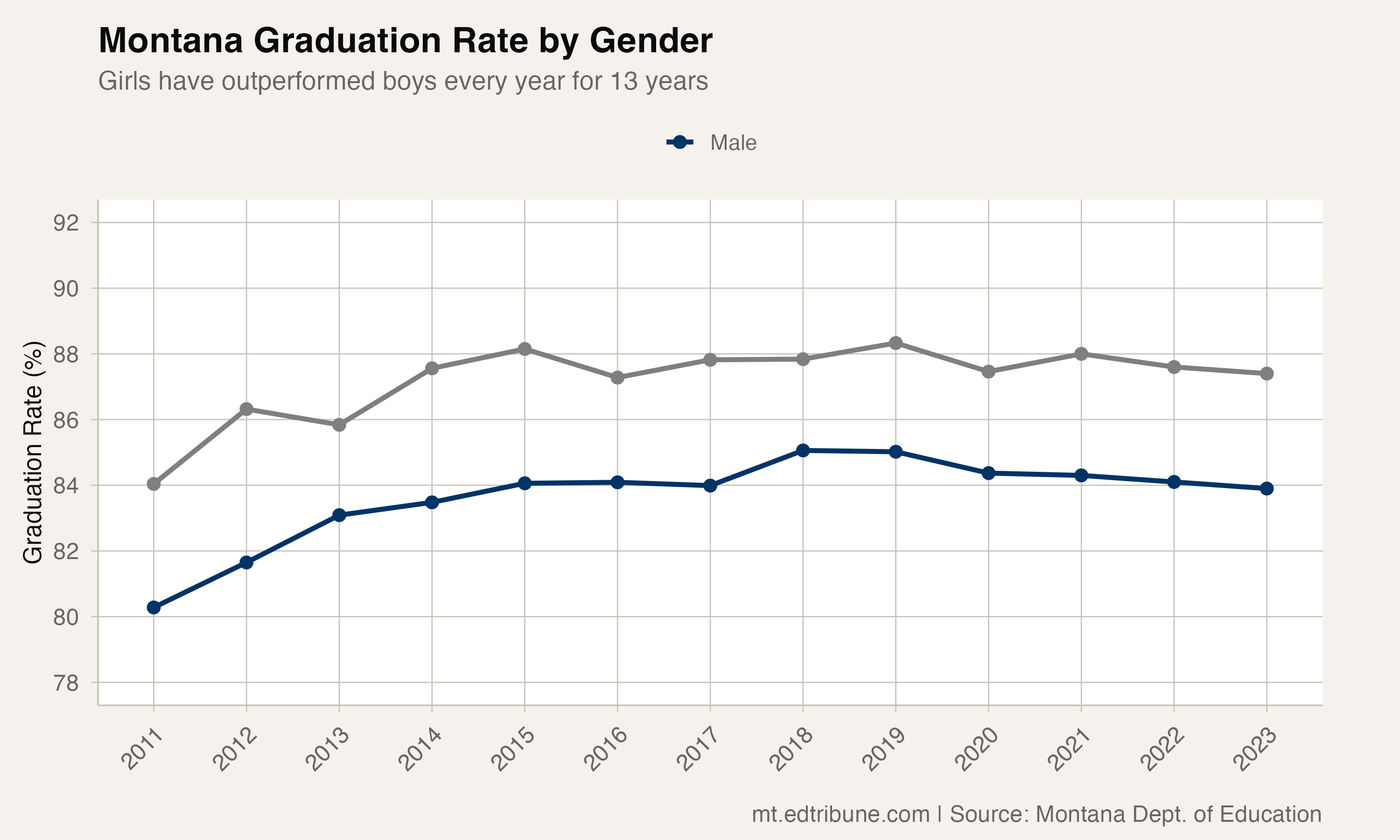
The female graduation rate and the male graduation rate have tracked each other almost perfectly for 13 years, maintaining a consistent gap while moving up and down together. When the female rate climbed from 84.0% to 88.3% between 2011 and 2019, the male rate climbed from 80.3% to 85.0%. When the female rate dipped in 2020, the male rate dipped too.
Both genders improved at nearly identical rates over the full period: females gained 3.4 points (84.0% to 87.4%), males gained 3.6 points (80.3% to 83.9%). The gap did not widen because both groups moved at the same pace. It did not narrow for the same reason.
The shape of the gap
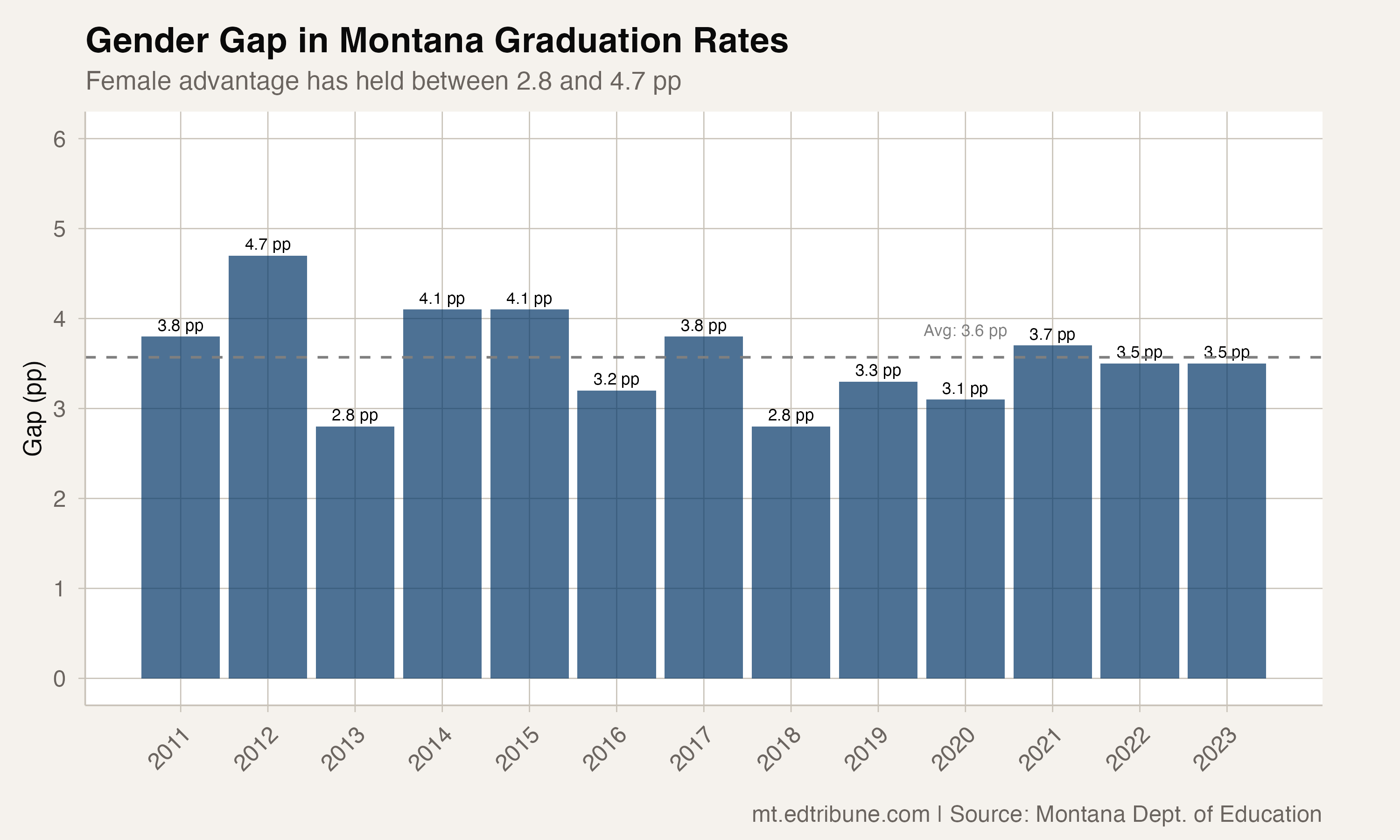
The year-to-year variation in the gap is modest. It peaked at 4.7 points in 2012 and hit its floor at 2.8 points in 2013 and 2018. The average across all 13 years is 3.6 points.
The gender gap, at 3 to 4 points in most years, is smaller than several other differences reported in Montana's graduation data. The public file used here does not cross-tabulate gender with race, poverty or other student characteristics, so it cannot show how the gap varies within those groups.
The question nobody is asking
The data establish a persistent difference, not its cause. Across 13 reported years, Montana boys never matched the female four-year graduation rate.
Detailed code that reproduces the analysis and figures in this article is available exclusively to EdTribune subscribers.
Discussion
Sign in to join the discussion.
Loading comments...