Lance Olson came to Froid because of what was already working there.
"Froid is an excellent school that has been doing very well academically the past several years," he wrote in answers to written questions from The MTEdTribune. "The staff here is outstanding with a true desire to see student success. I felt that this is something that I could add to."
Olson signed his superintendent contract with Froid Public Schools on August 6, he wrote, and the 2026-27 school year is his first in the job. He leads both halves of a system the district calls District 65 and 65E and Montana reports as two separate records, Froid Elem↗ET for kindergarten through eighth grade and Froid H S↗ET for grades 9 through 12.
Olson came to administration by way of the classroom. "My education background started teaching ESL in China, where I taught for 6 years," he wrote. He later worked at several Class C schools and in Hardin, where he served as a GEAR UP liaison. "We started Dual Enrollment as well as EMT and CNA classes," he wrote of his time in Hardin.
Before Froid, he was superintendent at Custer. "I was Superintendent at Custer for 3 years where we also started CNA and Dual Enrollment classes while expanding the Work Study program," he wrote. Custer K-12 Schools appears among the districts identified as successful in a study prepared for the Legislature's School Funding Interim Commission by APA Consulting in August 2026.
"I am a strong believer in what students can achieve when they see their own potential," he wrote.
He follows Steve Mayhue, who arrived as Froid's superintendent in 2023, according to the Northern Plains Independent, and who is now listed as superintendent of Lockwood Public Schools.
A first year spent on how the school runs
Olson's plans for this year are about the machinery of the district rather than a new program.
"The focus of this year is improving the structure and functionality of the school," he wrote. "We are working on safety plans, handbooks, building projects, and policy while cross training staff in various school functions."
That work happens at a small scale. In the most recent year Montana has published, 2025-26, Froid's two districts together enrolled 78 students across three schools: 36 at Froid Elementary School, 7 at Froid 7-8 and 35 at Froid High School. The state enrollment record does not cover staffing, so it cannot show how the cross-training will be organized.
Two districts, two directions
Olson did not describe Froid's enrollment as a problem to be solved. He described it as something moving through the building.
"All small towns in Montana are in a state of flux for enrollment," he wrote. "In the Northeast it is a bigger shift due to the oil markets."
The state record shows how much flux that can mean. The elementary district enrolled 43 students in 2025-26, down from 90 in 2017-18. That is 47 fewer students, a decline of 52.2%. Over the same nine published years, the high school district went the other way, from 24 students to 35, an increase of 11 students or 45.8%.
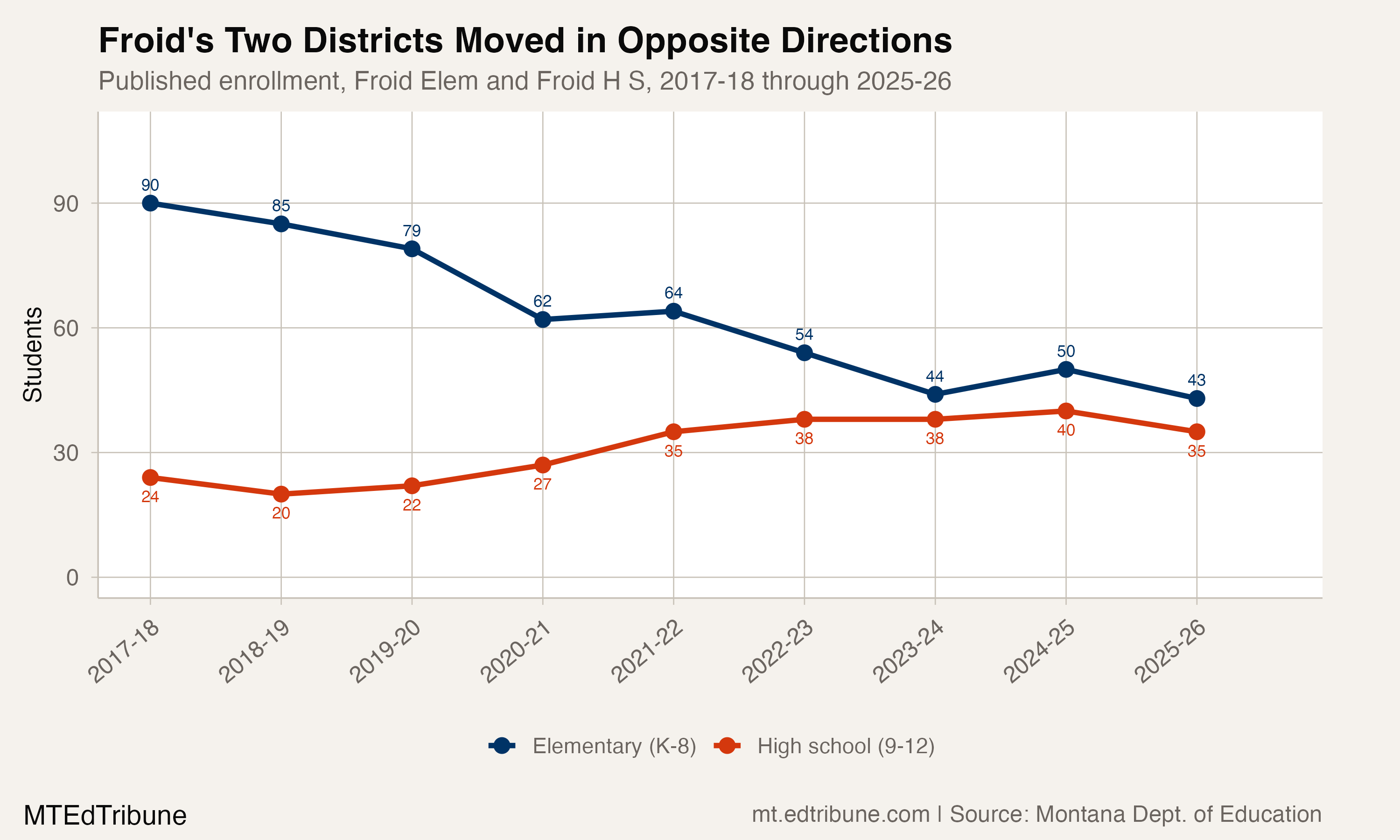
Put together, the two published totals fell from 114 to 78, a decline of 36 students or 31.6%. That is smaller than the elementary decline alone, because the high school grew by 11 during the same years. The 78 students in 2025-26 are the lowest combined total in the nine years Montana has published. Statewide, Montana's published enrollment fell 3.2% between the same two years. Olson called the statewide decline "a big concern," but he wrote that "in Froid, the issue is not homeschool numbers or students moving to online."
The path between those endpoints was not smooth. The elementary district's largest single-year drop came in 2020-21, when it fell by 17 students, from 79 to 62. The high school district peaked at 40 students in 2024-25 and then fell by 5 to reach 35 the following year.
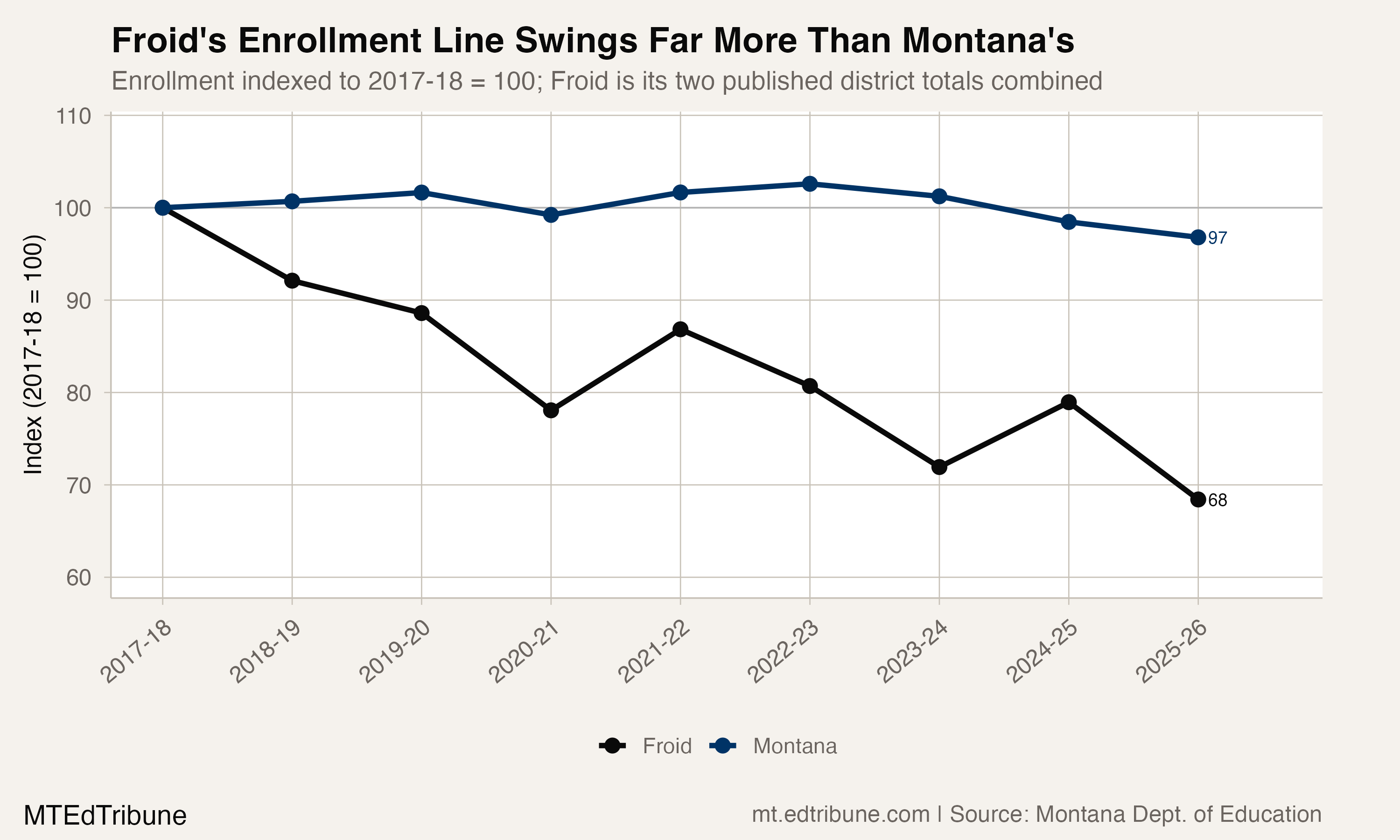
On a base this small, a handful of families arriving or leaving shows up as a visible swing in the line, which is why the percentages above run so much larger than the state's. The state file records that these counts happened. It does not record why, and this article does not assign a cause beyond Olson's own account.
"Most of that is due to 3 small grades"
Olson's reading of the decline is about specific classes rather than a steady drain.
"In Froid, our enrollment has been decreasing, but most of that is due to 3 small grades," he wrote.
Montana published a full grade-by-grade count for Froid in 2025-26, and every grade row adds up exactly to the two published district totals, so nothing in it is suppressed. Grades ranged from 3 students in eighth grade to 10 in eleventh. Five of the 13 grades held four students or fewer.
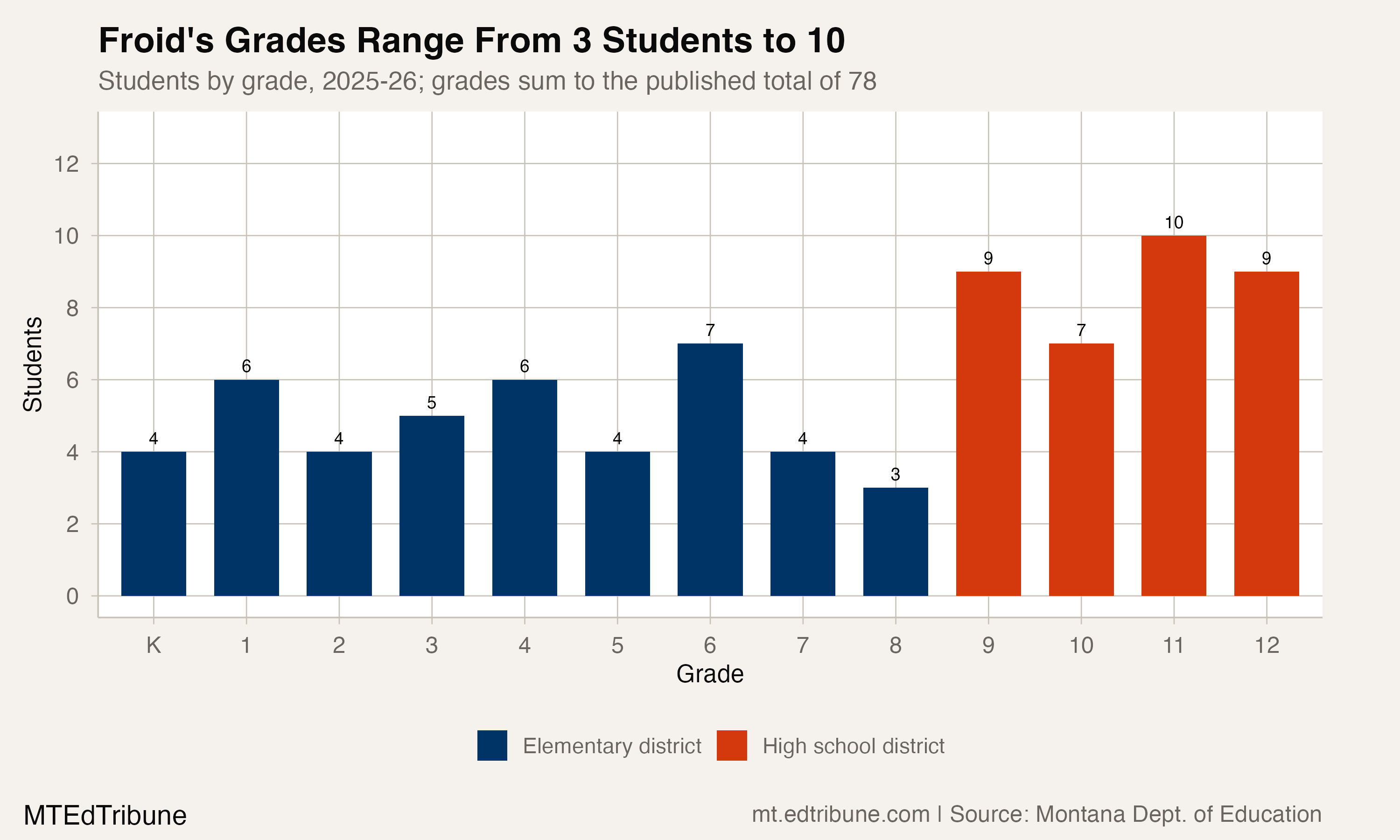
The file cannot say which three grades Olson means. Several grades are about the same size, and Montana published Froid's grade rows only for 2025-26, so no class can be followed from one year to the next. What the file does show is the shape he is describing. Seventh and eighth grade, the two classes next in line for the high school, held 7 students between them. Eleventh and twelfth grade, the two classes closest to graduating, held 19.
Olson expects that shape to play out over the next several years.
"Over the next few years, our HS will continue to shrink and the elementary will grow, then the HS will begin increasing again," he wrote.
That is his expectation, and it is his to make. The published record covers students already enrolled through 2025-26, and this article makes no projection of its own. The state has not yet published 2026-27 counts, and current-year figures will differ once it does.
Why he is not worried
Olson named two things that could change the picture from outside the school.
"There is always the chance that industry will bring families to the area, and Froid's outstanding academics are a draw as well," he wrote. "I'm not overly concerned about enrollment at this point."
The academic side of that statement has outside support. The same School Funding Interim Commission study identified successful Montana districts using state test results to measure high performance, growth, and results above what each district's circumstances would predict. Both of Froid's districts are on that list: Froid Elem among the elementary districts and Froid H S among the high school districts. The Commission's final report to the Legislature notes that success was narrowly defined for the study, and that the listed districts may not be the only successful ones in the state.
The totals he inherits are the smallest in the state's nine-year record for Froid. The shape inside them, a thin middle and a fuller high school, is the one he says will turn over as the smallest classes move through. Montana's next enrollment release will be the first published count from his time in the job, and the first chance to see whether the elementary district begins to grow, as he expects.
Enrollment, school and grade figures come from the Montana Office of Public Instruction published enrollment record, end_year 2018 through 2026. Montana publishes Froid as two district records, an elementary district and a high school district; combined figures in this article are the sum of those two published totals. Mr. Olson answered written questions from The MTEdTribune in September 2026 and sent written comments after reviewing a draft of this article, and all quotations come from those written responses. The list of successful districts comes from the Montana Successful School Districts Study Report, prepared by APA Consulting for the School Funding Interim Commission and dated August 10, 2026.
Detailed code that reproduces the analysis and figures in this article is available exclusively to EdTribune subscribers.
Discussion
Sign in to join the discussion.
Loading comments...